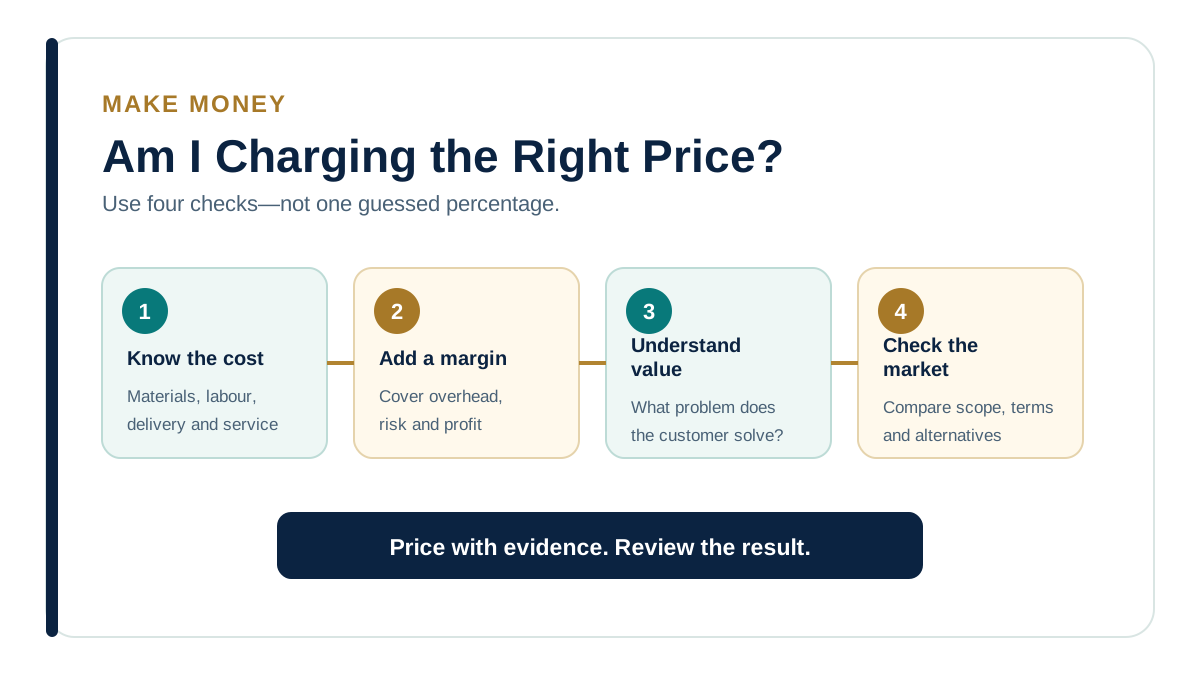
The right price is not simply your cost plus a guessed percentage. It must cover the cost of fulfilling the sale, contribute to the cost of running the business, reward the risk taken—and still make sense to the customer.
Practical Guide by Thiagan ManikamPlain explanation · Example · Action to take
The Short Answer
A suitable price should cover the relevant cost, contribute to overheads and profit, reflect customer value and remain commercially realistic.
At A Glance
Pricing checkQuestion to ask
CostWhat does the sale or job truly require?
MarginWhat contribution and profit are needed?
MarketWhat alternatives can the customer choose?
ValueWhat outcome or service does the customer receive?
A Simple Example
A job priced at RM10,000 with RM7,500 of relevant costs contributes RM2,500, or 25% of sales, before shared overheads.
What To Do
Step 1. Build the price from reliable costs.
Step 2. Set a minimum acceptable contribution.
Step 3. Compare actual with quoted costs.
Step 4. Review prices when costs or service requirements change.
Avoid These Mistakes
Copying a competitor without knowing its costs
Applying one mark-up to every job
Ignoring delivery and support
Leaving prices unchanged while costs rise
Key Takeaway
Price with cost, margin, market and value in view.
Read More Detail
Start with what “right” means
A price is too low when normal sales cannot cover the related costs and a fair share of business overhead. It may also be too low when demand is strong but the business lacks the people or capacity to serve customers properly. A price can be too high when customers do not see enough value, comparable alternatives cost less, or the quotation includes features they do not need.
There is rarely one perfect figure. A useful pricing decision normally combines four checks: cost, sustainable margin, customer value and the market. Cost gives you a floor to investigate. Value and market conditions indicate what customers may accept. Your capacity, payment terms and business strategy influence the final decision.
Selling price − costs attributable to the sale = contributionContribution must help cover overhead and profit; it is not automatically net profit.
A realistic Malaysian SME example
Imagine a small Klang Valley service company quoting for a recurring monthly maintenance job. It expects 20 technician hours, materials, travel and occasional subcontractor support. The figures below are illustrative and exclude SST or other taxes that may apply to a particular business.
Cost and price itemAmount
Technician time: 20 hours × RM50RM1,000
Materials and consumablesRM600
Travel and deliveryRM200
Expected subcontractor supportRM200
Direct and attributable costRM2,000
Proposed selling priceRM3,000
Contribution: RM3,000 − RM2,000RM1,000
The RM1,000 contribution equals 33.3% of the selling price. It helps pay office rent, administration, software, management time and other shared overhead before any net profit remains. Whether RM3,000 is sufficient depends on the company’s total overhead, available capacity, service risk and the value of reliable maintenance to the customer.
Do not confuse margin with mark-up. Here, the RM1,000 profit contribution divided by RM3,000 sales is a 33.3% margin. Divided by RM2,000 cost, it is a 50% mark-up. Using “30%” without saying which one can produce the wrong quotation.
Know the full cost before negotiating
Begin with costs that arise because you accept the order: products or materials, productive labour, subcontractors, commission, packaging, delivery, payment charges, warranty work and expected wastage. For a job, record actual hours and materials against a job number so the next quotation is based on evidence rather than memory.
Then consider overhead. Rent, administrative salaries, accounting, insurance and software may not belong to one order, but your total contribution must cover them. Use the break-even guide to understand how much monthly contribution the business needs. If reliable costing is unavailable, first improve the records; a precise-looking price based on missing costs is still unreliable.
Check value and the market
Competitor prices are useful reference points, but they do not reveal the competitor’s costs, quality, capacity or strategy. Instead of copying a price, compare what is included: delivery time, warranty, response time, minimum order, credit period, technical support and the risk carried by each party.
Ask what problem the customer is solving. A fast repair that prevents costly downtime may create more value than routine work, while a standard item available from many suppliers may be price-sensitive. Speak to customers who accepted and rejected quotations. Record the reasons without assuming every lost order was caused by price.
Payment terms also matter. RM10,000 received immediately is not the same cash position as RM10,000 collected after 90 days. Late collection does not automatically make a customer unprofitable, but financing effort, collection work and credit risk should be reviewed when agreeing terms.
Test every discount before approving it
A discount reduces contribution faster than many owners expect. Suppose an item sells for RM100 and has RM70 attributable cost. Contribution is RM30. A 10% discount reduces the selling price to RM90, but the cost remains RM70, so contribution falls to RM20—a 33.3% reduction in contribution. The business would need 50% more units at RM20 contribution to earn the same total contribution as before, assuming capacity and costs remain unchanged.
A discount may still be sensible for a larger order, faster payment, lower delivery cost or unused capacity. Link it to a clear benefit and set approval limits. Avoid giving a permanent discount merely because a customer asks.
Practical pricing steps
Choose one product, service or job. Use a recent normal example rather than trying to rebuild every price at once.
Calculate attributable cost. Include materials, productive labour, delivery, commission, rework and other costs caused by the sale.
Set a contribution requirement. Check the contribution needed to cover monthly overhead and the desired return.
Compare value and alternatives. Document what the customer receives and what competing offers include.
Test changes. Calculate the ringgit effect of a discount, supplier increase, longer credit period or lower volume before approval.
Monitor the result. Compare the quoted cost with the actual cost and review prices when inputs, scope or capacity change.
Common mistakes
Adding a percentage to purchase cost while ignoring labour, delivery, wastage or service time.
Confusing mark-up with margin when preparing quotations.
Copying a competitor without comparing scope, quality and payment terms.
Keeping old prices after supplier, salary or exchange-rate-related costs have changed.
Giving discounts without calculating the contribution lost or receiving something in return.
Using one margin for products, customers or jobs with very different cost and service demands.
Increasing every price automatically without considering customer value, demand and contractual obligations.
Quick pricing checklist
Costs are current and supported by records
Direct labour, delivery, rework and payment costs are considered
Margin and mark-up are clearly distinguished
The price contributes enough toward overhead and profit
Customer value and comparable alternatives are understood
Discounts and credit terms have clear approval limits
Quoted cost is compared with actual cost after delivery
Prices are reviewed when cost, scope or capacity changes
When professional help may be useful
Consider help from an accountant or financial management adviser when product costs are incomplete, jobs regularly exceed quoted hours, margins vary widely, or price changes could affect major contracts. They can help build a repeatable costing and profitability report, test scenarios and separate contribution from net profit.
For SST, income tax, competition law, contract terms or regulated pricing, obtain advice from an appropriately qualified tax or legal professional. This article is general education and does not determine the correct price or legal treatment for an individual business.