The Short Answer
List the cash expected to be received and paid during each of the next three months. Calculate the closing balance for every month, then compare the lowest balance with the minimum amount the business wants to keep available.
What To Forecast
A Simple Three-Month Example
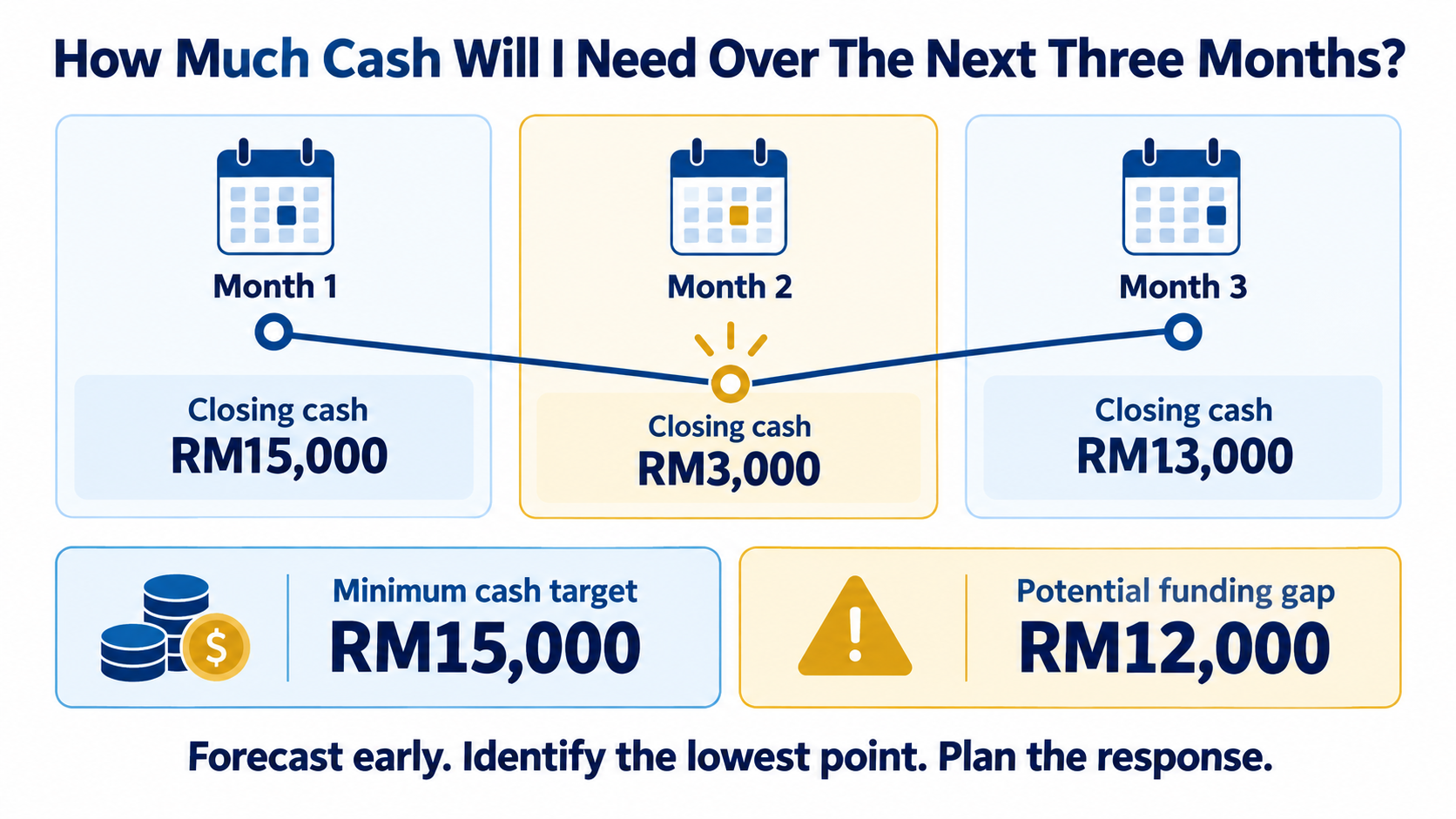
The example below starts with RM25,000. Cash falls to RM3,000 in Month 2 before improving in Month 3.
If management wants to maintain at least RM15,000, the lowest projected balance of RM3,000 indicates a potential RM12,000 gap in Month 2. This does not automatically mean the business must borrow RM12,000. It means action should be planned before Month 2.
What To Do Next
Read The More Detailed Answer
Begin With Usable Opening Cash
Start with cash that the business can genuinely use. Exclude restricted deposits and amounts already committed to immediate payments. If the business uses an overdraft, show the bank position clearly and record the available facility separately rather than treating it as cash received.
Forecast Receipts By Collection Date
Sales do not create cash until customers pay. Begin with the receivables listing and estimate when each material invoice is likely to be collected. Use customers’ actual payment behaviour, current disputes and missing documents—not merely the contractual due date.
Record Payments When Cash Will Leave
Include supplier payments, payroll, statutory contributions, rent, utilities, tax instalments, loan repayments, insurance, asset purchases and owner withdrawals. Annual or quarterly payments can easily be missed when management looks only at a normal month.
Separate essential payments from spending that may be reduced or postponed. This makes the forecast useful for decisions if cash becomes tight.
Use Weekly Detail For The Near Term
A three-month summary is helpful for direction, but a monthly total can hide a shortage occurring in the middle of the month. Prepare the first four to six weeks by week, especially when payroll and supplier payments fall due before customer receipts.
Test A More Difficult Scenario
The main forecast should show management’s realistic expectation. Add a separate pressure test rather than quietly making every figure pessimistic.
If a small change creates a serious shortage, management needs a stronger reserve or a confirmed contingency plan.
Plan The Response Before Cash Runs Low
Begin with operational action: accelerate valid collections, invoice promptly, resolve disputes, control stock purchases and postpone non-essential spending. Discuss revised terms early where appropriate. If funding may be needed, approach the bank or other legitimate funding source while the business still has time to provide information and compare terms.
Do not solve a continuing loss merely by adding more borrowing. If the forecast remains weak every month, investigate pricing, margin, overhead, stock, collections and the underlying business model.
Review Assumptions And Ownership
Assign responsibility for major collections and payments. At each weekly review, compare forecast with actual results, explain significant differences and update the following weeks. The purpose is not to predict every ringgit perfectly; it is to identify pressure early enough to act.
Avoid These Mistakes
- Using expected sales instead of expected customer collections.
- Assuming every customer will pay on the due date.
- Omitting tax, loan, annual or one-off payments.
- Counting unapproved financing as available cash.
- Preparing the forecast once and not updating it.
Quick Review
- Is the opening cash balance genuinely available?
- Are receipts based on realistic collection dates?
- Are all essential and irregular payments included?
- What is the lowest projected cash balance?
- What action must be completed before that date?
Key Takeaway
The business needs enough cash to remain above its minimum target at the lowest point in the forecast. Update the forecast weekly and plan collections, spending changes or funding before the gap becomes urgent.
This guide provides general educational information. Funding, tax and solvency decisions should be assessed using the business’s actual circumstances and appropriate professional advice.