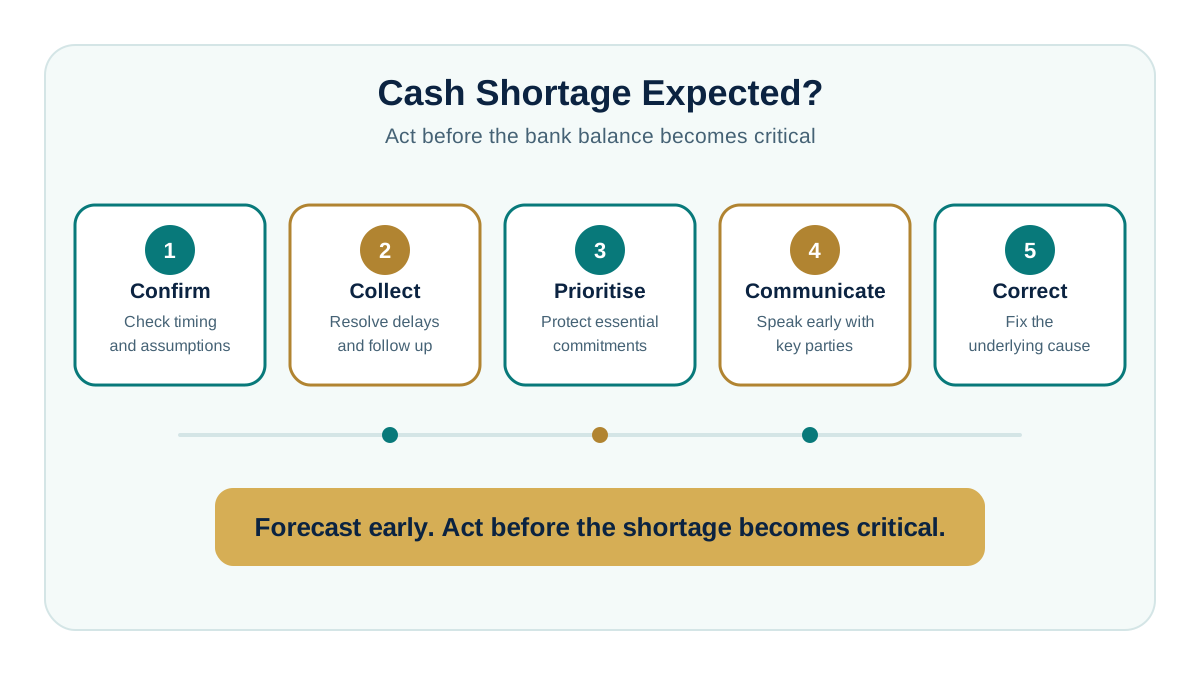
What Should I Do When a Cash Shortage Is Expected?
A forecast showing insufficient cash can be uncomfortable, but it gives management something valuable: time. The earlier the gap is identified, the more choices the business may have. The first response should not be to delay every payment or borrow immediately. Confirm the forecast, understand the cause and take coordinated action before the shortage becomes critical.
The Short Answer
Act before the shortage becomes critical. Confirm the forecast, improve genuine collections, prioritise payments, communicate early and correct the underlying cause.
At A Glance
ActionPurpose
ConfirmCheck balances, dates and missing payments
CollectResolve invoice disputes and follow up commitments
PrioritiseProtect payroll and essential operations
CommunicateSpeak to suppliers or financiers early
CorrectAddress recurring losses or working-capital problems
A Simple Example
If the forecast shows cash falling to negative RM5,000 in Week 3, test customer delays and agree specific actions before that week arrives.
What To Do
Step 1. Prepare expected, pressure and action scenarios.
Step 2. Give each collection a named owner.
Step 3. Record revised payment dates.
Step 4. Update the forecast whenever facts change.
Avoid These Mistakes
Borrowing before understanding the cause
Delaying every payment
Counting uncertain receipts
Moving the problem into a later week
Key Takeaway
Use the early warning to confirm, collect, prioritise, communicate and correct.
Read More Detail
First, confirm that the forecast is realistic
A cash forecast is only as useful as its assumptions. Review the opening bank balance and expected receipts and payments for each week. Remove receipts that are merely hoped for and use dates based on customer commitments and actual payment patterns. Include payroll, statutory payments, suppliers, rent, financing, tax, planned purchases and other commitments.
Check for duplicated payments, missing supplier invoices and amounts that belong in another period. Separate committed payments from optional or deferrable spending. If there are several bank accounts or facilities, confirm the balances and restrictions on each one.
Opening cash + expected receipts − expected payments = forecast closing cashCalculate the position by week so the timing of the lowest point is visible.
A simple three-week example
Suppose a business expects RM35,000 at the start of the month. The forecast shows customer collections of RM45,000 and payments of RM58,000 in Week 1, leaving RM22,000. In Week 2, only RM25,000 is expected from customers while payroll, suppliers and other commitments total RM39,000. Cash falls to RM8,000. Week 3 then requires RM28,000 of payments, but only RM15,000 is expected to be collected.
ForecastWeek 1Week 2Week 3
Opening cashRM35,000RM22,000RM8,000
Expected receiptsRM45,000RM25,000RM15,000
Expected payments(RM58,000)(RM39,000)(RM28,000)
Closing cashRM22,000RM8,000(RM5,000)
The expected RM5,000 shortfall is the minimum gap under these assumptions. Management should also test what happens if a major customer pays one week later or an essential payment is higher than expected.
Accelerate genuine customer collections
Start with the largest and most time-sensitive receivables. Confirm that invoices, delivery documents and statements were sent correctly. Resolve disputes or missing documents promptly. Where a customer has promised a payment date, record it and follow up before the date—not only after it is missed.
Do not assume that repeated reminders will collect every overdue invoice. Identify the actual cause of delay, the person responsible for removing it and a realistic expected date. Consider whether future orders should follow revised credit limits, deposits, milestone billing or shorter terms. Any change should be commercially sensible and consistent with agreed contracts.
Prioritise payments carefully
List payments by date and consequence. Payroll, statutory obligations, essential suppliers, rent, financing commitments and services needed to continue operating may require different treatment from discretionary purchases or expenditure that has not yet been committed.
Deferring a payment does not remove it; it moves the pressure into a later week. Avoid paying only the most persistent supplier while overlooking obligations that could interrupt operations or create serious consequences. Record every revised date in the forecast so management can see whether the action solves the gap or merely postpones it.
Communicate before commitments are missed
If a supplier payment may be delayed, contact the supplier early with a realistic proposal. A specific request—such as splitting an invoice into two dated payments—is more useful than a vague promise. Preserve critical supply relationships and do not agree to a date the business is unlikely to meet.
If the business may need additional funding, begin the discussion before the bank balance reaches a critical level. Prepare current accounts, receivables and payables schedules, the cash forecast, the reason for the gap and a credible repayment plan. Borrowing may provide time, but it is not a substitute for correcting a loss-making operation or recurring working-capital problem.
Address the underlying cause
Once the immediate gap is controlled, ask why it arose. Common causes include slow customer collections, excessive stock, low margins, rapid growth, large owner withdrawals, unplanned asset purchases, debt repayments or losses that are not yet obvious from the bank balance.
A timing gap may be manageable if profitable sales will convert to cash shortly. A structural gap is more serious: the business repeatedly spends more cash than it generates. That may require changes to pricing, costs, customer terms, stock purchasing, financing structure or the scale of operations. The action should match the cause.
Test three scenarios
Expected case. Use the most realistic receipt and payment dates based on current information.
Pressure case. Delay major customer receipts and include plausible cost increases or urgent payments.
Action case. Add specific collection actions, agreed payment changes and approved funding, using dates that can be supported.
Compare the lowest cash point in each scenario. This shows how much headroom is required and which assumptions create the greatest risk. Update the forecast whenever a material receipt or payment changes.
Common mistakes to avoid
Waiting for the bank balance to become critical before preparing a forecast.
Using invoice due dates without considering how customers actually pay.
Counting uncertain sales enquiries as confirmed cash receipts.
Delaying suppliers without recording the new dates or communicating with them.
Cutting essential spending that is needed to fulfil profitable orders.
Borrowing to cover recurring losses without a corrective plan.
Paying owner withdrawals without considering upcoming business commitments.
Preparing the forecast once and leaving it unchanged as events move.
Cash-shortage action checklist
What is the lowest forecast cash balance, and in which week does it occur?
Which receipts are confirmed, probable or uncertain?
Which overdue invoices have a named action owner and follow-up date?
Which payments are essential, committed or deferrable?
Have affected suppliers or financiers been contacted early?
What happens if the largest expected receipt is delayed?
Is the gap temporary, or does it recur every month?
Which underlying cause will management correct, and by when?
When professional help may be appropriate
Seek help promptly when the forecast shows that payroll, statutory obligations or essential suppliers may not be paid; available facilities are nearly exhausted; lenders or suppliers have issued formal demands; or the business cannot determine whether the gap is temporary or structural. An accountant, financial management adviser, licensed insolvency practitioner or appropriately qualified legal adviser may be needed depending on the seriousness and circumstances.
This guide is general educational information. Funding, payment, tax, employment and insolvency decisions can have significant consequences and should be assessed using the business’s actual position and appropriate professional advice.