The Short Answer
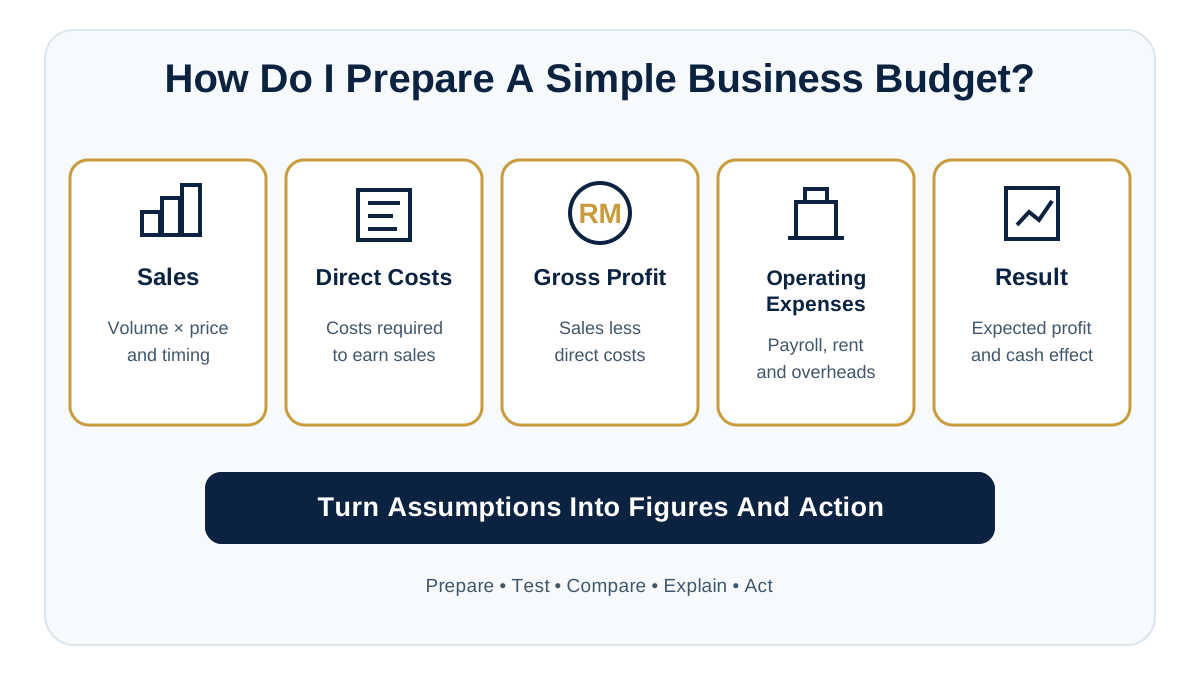
Begin with realistic sales assumptions. Estimate the direct costs required to earn those sales, then include payroll, rent and other operating expenses. Calculate the expected profit and separately check when the related cash will be collected and paid.
A Simple Monthly Example
A service business prepares the following budget for one month. The figures are illustrative.
The budget shows a RM7,000 operating profit if sales reach RM100,000 and the expected 40% gross margin is achieved. Management should now test whether the sales volume, prices and costs are realistic—and whether customer cash will arrive before major payments fall due.
Read The More Detailed Answer
Start With The Business Plan, Not A Spreadsheet
List what the business expects to do during the budget period. Consider confirmed orders, recurring customers, seasonal patterns, planned price changes, new staff, equipment, marketing activity and capacity limits. The figures should reflect an operating plan rather than simply increasing last year’s numbers by a percentage.
Build Sales From Clear Assumptions
Estimate sales by product, service, job, customer group or branch—whichever view management can monitor. Separate volume from selling price so the reason for each figure remains visible.
Link Direct Costs To Sales
Estimate materials, goods purchased for resale, productive labour, subcontractors, commissions, delivery and other costs that change with activity. Use a realistic gross margin supported by recent results and known price changes. Do not assume costs remain unchanged when sales volume changes.
Budget Operating Expenses Separately
List recurring expenses such as salaries, rent, utilities, software, insurance, professional fees, repairs and marketing. Then add known one-off items in the month they are expected. Separate fixed commitments from costs that management can adjust.
Prepare More Than One View
A single forecast can create false confidence. Test a cautious case and a stronger-sales case so management can see the range of possible results.
This simplified comparison assumes a 40% gross margin and RM33,000 of operating expenses in every scenario. In practice, verify whether overtime, delivery, commission or other costs would rise with activity.
Prepare A Separate Cash View
Profit does not show when cash is collected or paid. Convert the budget into a monthly or weekly cash forecast using expected collection dates, supplier terms, payroll dates, loan instalments, tax payments and planned asset purchases. A profitable budget may still create a temporary cash shortage.
Compare Actual Results With Budget
At month-end, compare actual sales, gross profit, expenses and cash with the budget. Record the amount of each important difference, explain the cause, assign an action owner and agree on a review date.
Avoid These Mistakes
- Copying last year’s figures without documenting assumptions.
- Budgeting sales beyond the business’s available capacity.
- Ignoring discounts, delivery, commissions and other direct costs.
- Confusing budgeted profit with cash available.
- Preparing only an optimistic case.
- Leaving the budget unchanged when important assumptions change.
- Comparing actual results with budget without assigning corrective action.
Quick Review
- Sales assumptions show volume, price and timing
- Direct costs are linked to expected activity
- Recurring and one-off expenses are included
- Cautious and stronger-sales scenarios are tested
- Profit is converted into a separate cash forecast
- Actual results will be compared with budget monthly
- Material differences will have an explanation and action owner
Key Takeaway
A simple budget should connect assumptions, figures and management action. Prepare it in enough detail to understand what drives the result, but keep it practical enough to update and review every month.
This guide is general educational information. Budget assumptions and accounting treatment should be adapted to the business’s circumstances and applicable requirements.