Why Is There Not Enough Cash Despite Making a Profit?
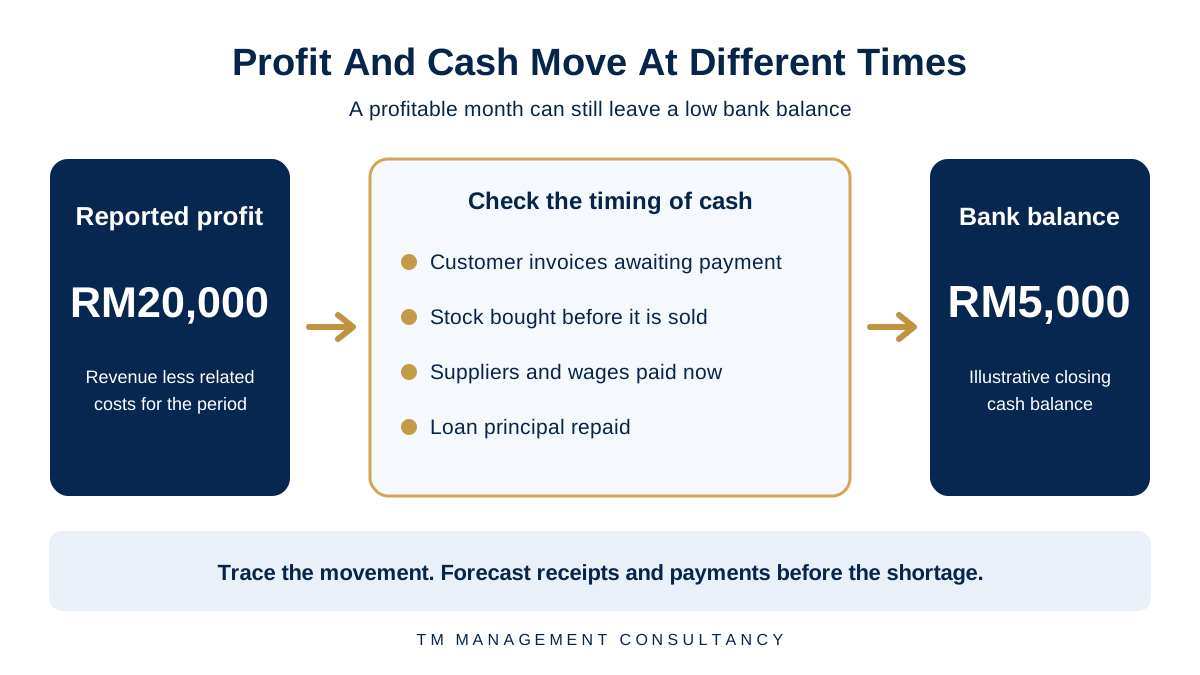
Your Profit and Loss Account shows a profit, yet the bank balance is low and supplier payments are approaching. This is possible because profit records business performance while cash follows the timing of money received and paid.
Practical Guide by Thiagan ManikamPlain explanation · Example · Action to take
The Short Answer
Profit records income and costs when they are earned or incurred. Cash moves when customers pay, suppliers are paid, stock is bought, loans are repaid or owners withdraw money.
At A Glance
Where profit can become cash pressureWhat happens
ReceivablesSales are recorded before customers pay
InventoryCash is tied up until stock is sold and collected
Assets and loan principalCash leaves without the full amount becoming an expense
Owner withdrawalsCash reduces but business profit does not
A Simple Example
A profitable RM50,000 sale may not provide cash this month if the customer pays in 60 days, while salaries and suppliers are due now.
What To Do
Step 1. Reconcile profit to cash movements.
Step 2. Review receivable and inventory days.
Step 3. Prepare a 13-week cash forecast.
Step 4. Control capital spending and withdrawals.
Avoid These Mistakes
Treating profit as available cash
Ignoring balance-sheet movements
Growing sales without funding working capital
Waiting for the bank balance to become critical
Key Takeaway
Review profit, working capital and cash flow together.
Read More Detail
Profit and cash answer different questions
Profit broadly compares the revenue earned in a period with the related costs. Cash tells you how much money is available in the bank and when it moves. A sale on credit can increase revenue and profit this month even though the customer pays next month or later. Likewise, a supplier may be paid for stock before that stock is sold.
Some cash payments do not reduce this month’s profit by the same amount. Repaying the principal of a loan reduces cash and the loan balance; it is not normally an expense in the Profit and Loss Account. Buying equipment usually creates an asset, while its cost is recognised over time through depreciation. Tax payments and owner drawings can also draw on cash without matching the current month’s operating profit. The exact accounting treatment depends on the transaction, so use your records rather than assuming that every bank payment is an expense.
Profit is not the same as cash collected.Review the Profit and Loss Account, Balance Sheet and cash movement together.
A simple RM example
Imagine a trading SME reports RM20,000 profit for September. Its customer invoices include sales that have not yet been collected. During the same month it buys more stock, pays suppliers for earlier purchases and repays part of a loan. The following is an illustrative movement in cash, not a cash-flow statement or a direct calculation from profit:
Cash movementRM
Opening bank balance25,000
Customer cash received+45,000
Supplier, payroll and operating payments−52,000
Additional stock purchase paid−8,000
Loan principal repaid−5,000
Closing bank balance5,000
The bank falls by RM20,000 although the business reports RM20,000 profit. Those two RM20,000 figures happen to match in this example; there is no general rule that they will. The next step is to reconcile actual cash movements and balance-sheet changes to the accounting records, including any overdraft or restricted balances, before making a conclusion.
Where might the cash be?
Customers: Revenue may sit in receivables until invoices are paid. Review the ageing report by invoice, not just the total. Identify missing documents, disputes, agreed terms and customers who have stopped responding. A balance is not guaranteed to be collected simply because it appears in the ledger.
Inventory: Cash may be tied up in fast-moving, slow-moving or obsolete stock. Purchases can use cash now while sales happen later. Check stock quantities, movement, reorder decisions and whether the recorded value is still supportable.
Suppliers and other commitments: Paying older supplier balances can reduce cash without being a new expense in the current month. Payroll, rent, loan instalments, tax and equipment commitments may cluster before customer receipts. A stretched supplier balance may temporarily preserve cash but can create supply and relationship problems.
Business growth: More sales can require additional stock, deliveries and wages before customers pay. A growing business may need more working capital even when its margins are healthy.
Build a three-month view
Start with the actual bank balance. Reconcile bank accounts and distinguish available cash from restricted funds or an overdraft facility.
List expected receipts by week. Use invoice due dates, customer behaviour and confirmed orders. Keep uncertain collections visible instead of treating them as certain cash.
List payments by due date. Include suppliers, wages, rent, taxes, financing and planned stock or equipment purchases. Separate committed payments from optional ones.
Calculate a rolling closing balance. Opening cash plus expected receipts minus expected payments gives a projected balance. Carry it into the next week and update it as actual amounts arrive.
Test slower collections. What happens if a major customer pays 30 days late, or sales are below plan? Identify the first week the balance becomes tight.
Assign actions early. Resolve invoice disputes, agree realistic collection dates, review stock orders, phase optional spending or discuss facilities before a shortfall becomes urgent.
A forecast is a decision aid, not a promise. Update it weekly using actual bank movements and changes to expected receipts and payments.
Common mistakes
Assuming reported profit is cash that can be spent immediately.
Counting every overdue invoice as certain to arrive on its due date.
Looking only at total stock value instead of movement and usability.
Leaving loan principal, tax or equipment payments out of the cash plan.
Using an unreconciled bank balance or forgetting payments already authorised but not yet cleared.
Forecasting only a month-end balance when a shortage may arise midway through the month.
Questions for your next review
How much cash is available today after pending payments?
Which customer receipts are late or uncertain?
Is more cash tied up in stock or receivables than last month?
What payments fall due before the next major receipts?
Which week shows the lowest forecast balance?
Who owns each collection or spending decision, and when will it be reviewed?
One action today
Take your latest bank balance and list the five largest receipts and five largest payments expected in the next four weeks. Put dates beside them. If a payment falls before the cash you expect to fund it, investigate now rather than waiting for the next monthly accounts.
If the accounts and bank movements do not reconcile, ask your accountant or financial management adviser to help build a reliable starting point. Persistent cash pressure can have several causes; the figures need to be checked before choosing a remedy.