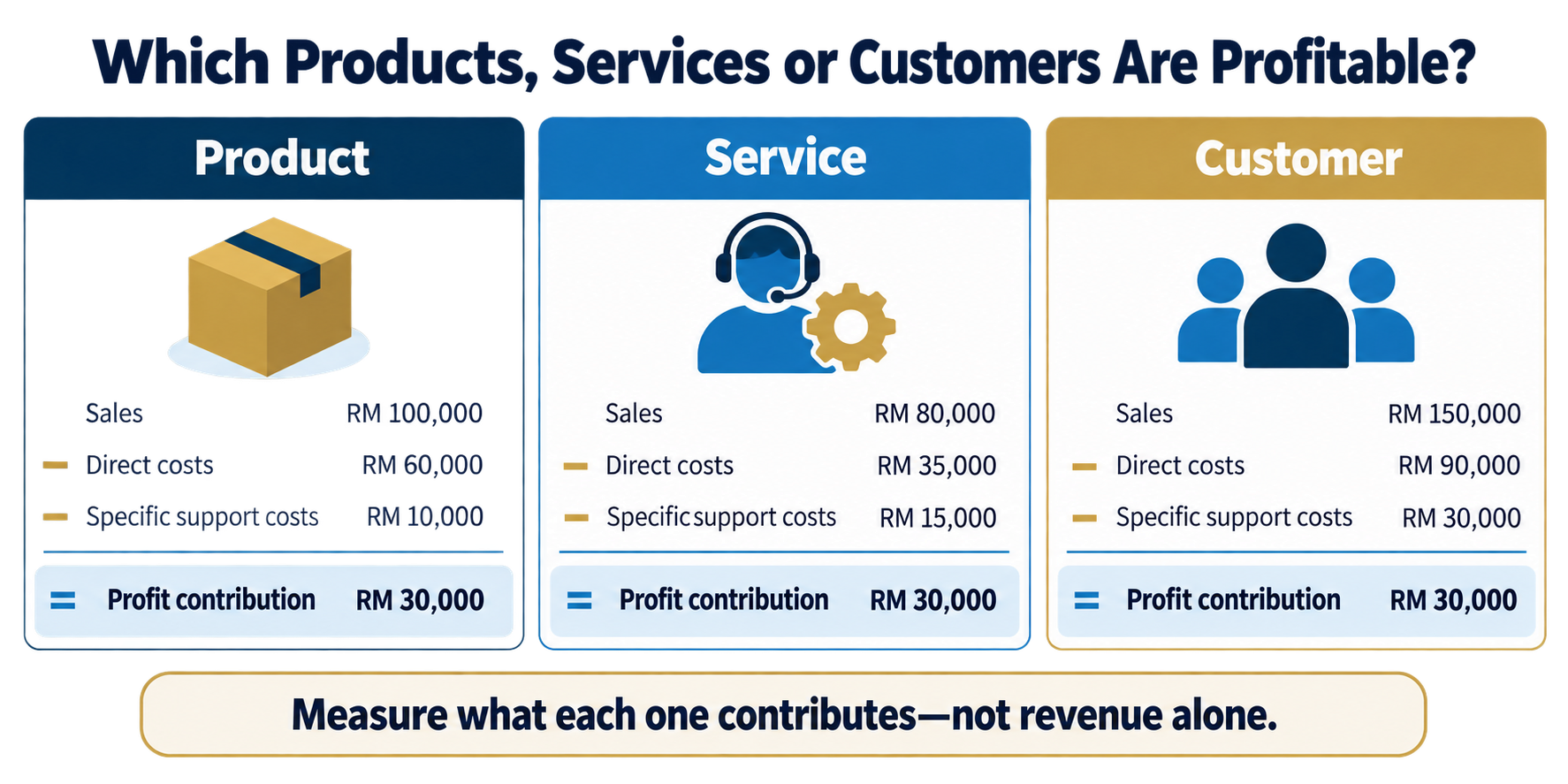
Begin with the decision you need to make
Are you deciding which product to promote, whether to renew a service contract, or how to price a customer? Choose that unit of analysis first. Gather sales and costs for the same period and use a consistent basis. A customer comparison, for example, may combine several products and jobs; a product comparison may include sales to many customers.
Start with net sales after discounts and returns. Then subtract costs that can reasonably be traced to that product, job or customer. These may include stock or materials used, subcontractors, delivery, sales commissions, special packaging, rework and directly attributable service time. The amount remaining is contribution toward shared overhead and profit. It is not necessarily final net profit.
Net sales − directly attributable costs = contributionContribution ÷ net sales = contribution margin
A simple customer comparison
Suppose a trading business reviews two customers for one month. These illustrative figures include invoiced sales after discounts, the cost of goods sold, and delivery and handling attributable to each customer. They exclude shared office costs, owner salary and tax.
Monthly figuresCustomer A / Customer B
Net salesRM50,000 / RM30,000
Goods sold(RM38,000) / (RM19,000)
Delivery and handling(RM5,000) / (RM2,000)
ContributionRM7,000 / RM9,000
Contribution margin14% / 30%
Customer A generates more revenue, but Customer B contributes RM2,000 more in this example. That is a reason to investigate prices and service costs, not an automatic reason to stop serving A. A may bring volume that supports purchasing terms or absorbs capacity that would otherwise sit idle. Additional overhead, credit losses and collection costs may change the fuller picture.
Follow the cost to the right place
For products, match units sold to their stock or production costs; review returns, wastage, freight and discounts. Unsold stock belongs in inventory, subject to appropriate valuation, rather than being charged to the products sold merely because it was purchased this month.
For services or jobs, record staff time, materials, subcontractors, travel and rework against a job reference. Compare the original quotation with actual hours and costs. For customers, combine the contribution from their purchases and include exceptional deliveries, support, rebates and other attributable costs. Review the customer’s payment pattern separately: late payment affects cash and may create financing or collection costs, but an overdue balance alone does not prove that the sale is unprofitable or uncollectible.
Shared costs such as office rent and management salaries still matter to the business as a whole. If you allocate them to customers, explain the basis and keep it consistent. An arbitrary allocation can make an otherwise useful customer look unprofitable. Compare both contribution and a clearly defined fuller profit measure where the decision requires it.
What to do with the result
- Choose one month or quarter. Reconcile the sales and cost totals to your accounting records before drawing conclusions.
- Start with a small sample. Compare a few major products, jobs or customers, including one with high sales and one with unusually high service demands.
- Check exceptions. Identify discounts, urgent deliveries, returns, rework and missing cost records. Speak with the staff who know why they occurred.
- Consider capacity and cash. Ask whether the work uses scarce people or equipment, and whether customers pay within agreed terms.
- Agree on a measured action. You might correct a price, set a minimum order, change delivery terms, reduce rework or improve collection follow-up. Assign an owner and a review date.
- Review the next period. Track whether contribution improved without losing valuable volume or damaging a sound relationship.
Common traps
- Comparing revenue alone, without discounts and the costs of fulfilling the sale.
- Comparing periods with different seasonal demand or incomplete job records.
- Using a single average margin for products with very different cost structures.
- Charging all shared overhead to one customer on an arbitrary basis.
- Calling contribution “net profit” before considering shared overhead and other costs.
- Making a pricing or customer decision from one unusual month without checking the reason.
Questions for your next review
- Can we identify sales after discounts and returns by product, job or customer?
- Are direct materials, goods sold, delivery and service time captured reliably?
- Which sales require unusually frequent exceptions or rework?
- Are we comparing contribution on the same basis and period?
- Which customer balances need collection action or further investigation?
- What action will we test, and when will we review its result?
When to get help
If your system cannot connect costs to sales, start by improving product codes, job references and the way deliveries or staff time are recorded. An accountant or financial management adviser can help reconcile the numbers and design a small, repeatable profitability report. This article is general education, not a conclusion about any particular customer or contract.