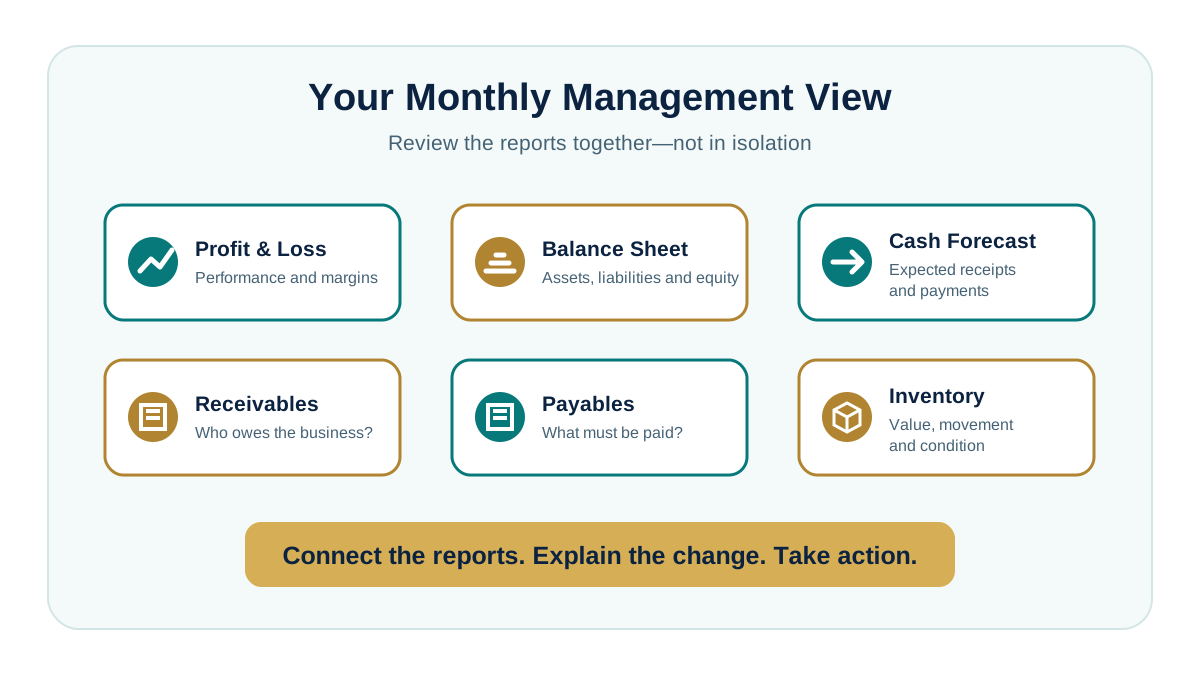
A Profit and Loss Account may show whether the business made a profit, but it cannot answer every management question. It does not, by itself, show whether customers are paying, whether stock is moving, whether supplier commitments are building up or whether cash will be sufficient next month. A useful monthly review connects a small set of reports and turns the findings into action.
Practical Guide by Thiagan ManikamPlain explanation · Example · Action to take
The Short Answer
Review profit, financial position, cash, customers, suppliers and stock together. No single report gives the complete picture.
At A Glance
Monthly reportMain question
Profit and LossDid the business earn a worthwhile profit?
Balance SheetIs the business financially stable?
Cash forecastCan upcoming payments be met?
Receivables ageingWhich customers are overdue?
Payables and inventoryWhat is due and where is cash tied up?
A Simple Example
Profit may improve while overdue customer balances rise faster, creating a cash problem that the Profit and Loss Account alone will not show.
What To Do
Step 1. Agree a monthly reporting date.
Step 2. Compare actual results with budget and prior periods.
Step 3. Investigate material changes.
Step 4. Assign actions, owners and review dates.
Avoid These Mistakes
Reviewing profit only
Receiving reports too late
Accepting unexplained balances
Discussing issues without assigning action
Key Takeaway
Review the reports together, investigate changes and turn findings into action.
Read More Detail
Begin with six connected reports
The exact pack should fit the size and complexity of the business. For many SMEs, the following six reports provide a practical starting point:
Profit and Loss Account. Shows income, direct costs, gross profit, operating expenses and profit for the period.
Balance Sheet. Shows what the business owns, what it owes and the owner’s accumulated interest at the reporting date.
Cash-flow forecast. Looks ahead at expected receipts, payments and the likely bank position rather than only reporting what has already happened.
Receivables ageing. Lists customer balances by age so overdue invoices and collection problems can be investigated.
Payables and commitments. Shows supplier balances and other payments due, helping management plan cash and avoid unexpected pressure.
Inventory or work-in-progress report. Shows the value and movement of stock or unfinished work, including slow-moving, damaged or unexplained balances.
Businesses with projects, branches or several product lines may also need job profitability, customer profitability, departmental results or selected operational indicators. Add a report only when it supports a real decision.
What the Profit and Loss Account should tell you
Do not stop at the final profit figure. Compare sales, gross profit and major expenses with the previous month, the same period last year, budget and year-to-date results where those comparisons are useful. Ask why the numbers moved.
A fall in gross margin may arise from discounts, higher purchase costs, product mix, wastage, rework or incomplete stock records. A large expense movement may reflect a genuine change, a timing difference or an incorrect posting. The report should help management identify the cause and the person responsible for the next step.
Report → Explain the movement → Assign action → Review the resultA report becomes useful when it leads to a decision or follow-up.
Use the Balance Sheet as a management report
A Balance Sheet can balance mathematically while individual balances still require attention. Compare current assets with current liabilities and review the important supporting schedules.
Is the bank balance reconciled? Do receivables agree with the customer ageing? Does the inventory figure agree with reliable stock records? Are supplier balances complete? Are loans, taxes, payroll liabilities and other commitments recorded? Unusual or old balances should be investigated rather than carried forward indefinitely.
The Profit and Loss Account explains performance over a period. The Balance Sheet shows the financial position at one date. Review them together because profit can rise while cash, debt collection or working capital weakens.
Look ahead with a cash-flow forecast
The bank statement reports the past; a forecast helps management prepare for the future. Start with the opening cash balance and list expected receipts and payments by week for at least the next several weeks. Use realistic collection dates rather than assuming every customer will pay on the invoice due date.
Include payroll, statutory payments, suppliers, rent, financing, tax, planned asset purchases and owner withdrawals. If the forecast shows a shortfall, management has time to improve collections, adjust the timing of discretionary spending, discuss supplier terms or arrange appropriate funding. A forecast is not a guarantee—it should be updated when assumptions change.
Turn ageing reports into action
A receivables ageing report should lead to specific collection activity. For each material overdue balance, record the reason for delay, the person responsible, the next action and a realistic expected payment date. An invoice may be held up by missing delivery evidence, a pricing dispute, an approval delay or a customer who has not kept a promise.
Review payables in the same disciplined way. Identify invoices due soon, disputed amounts, unrecorded commitments and suppliers whose terms are critical to operations. Delaying payments without communication may damage supply continuity and does not solve the underlying cash problem.
Review stock movement—not only stock value
Inventory uses cash before it produces sales. A stock report should distinguish fast-moving, slow-moving, damaged, obsolete and negative quantities. Compare stock growth with sales growth, review items with little recent movement and investigate significant differences between physical and system quantities.
The aim is not simply to reduce all stock. Insufficient inventory can interrupt operations or lose sales. Management needs enough reliable information to decide what to reorder, what to stop buying, what may require a discount and what needs further investigation.
A practical monthly review routine
Confirm reliability first. Complete reconciliations, cut-off checks, accruals and material stock adjustments before analysing trends.
Use consistent comparisons. Present actual results against suitable prior periods, budget or targets using the same definitions.
Focus on material exceptions. Highlight the few movements, overdue balances and risks that require management attention.
Connect the reports. Trace a sales increase through profit, receivables, inventory and cash rather than viewing each figure in isolation.
Record decisions. State the action, responsible person and completion or review date.
Follow up next month. Begin the next meeting by checking whether the previous actions were completed and what changed.
Common mistakes to avoid
Reviewing profit without the Balance Sheet and cash position.
Producing many pages of figures without highlighting decisions or exceptions.
Comparing months prepared using different cut-off or accounting treatments.
Accepting unexplained old balances because the accounts still balance.
Treating every overdue customer balance as equally collectible.
Using invoice due dates as forecast receipt dates despite a customer’s actual payment pattern.
Reviewing stock value without movement, condition or quantity information.
Ending the meeting without an action owner and review date.
Your monthly reporting checklist
Are all six reports prepared for the same reporting date?
Have the main accounts and supporting schedules been reconciled?
What changed materially from the previous comparison?
What caused the change, and is the explanation supported?
Which customers, suppliers or stock items require immediate attention?
Does the cash forecast show pressure before the next review?
What decisions were made, who owns them and when will they be checked?
When professional help may be useful
Consider help from an accountant or financial management adviser when reports arrive too late, balances cannot be reconciled, the business relies mainly on the bank balance, or management receives figures without useful explanation. A practical reporting pack should be short enough to review regularly, detailed enough to support decisions and consistent enough to reveal trends.
This guide is general educational information. The appropriate reports, accounting treatment and level of detail depend on the business and applicable requirements.