Why Does The Profit Shown In My Accounts Keep Changing?
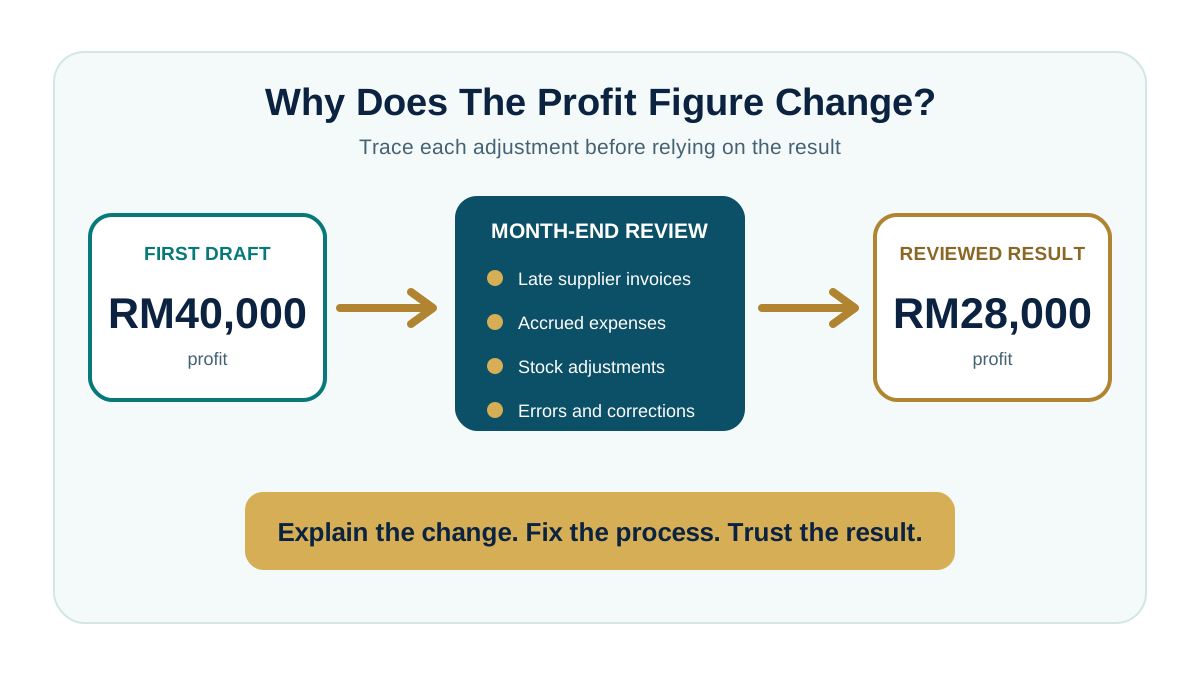
You receive a monthly Profit and Loss Account showing RM40,000 profit. A week later, the figure becomes RM28,000. It may feel as though the accounts cannot be trusted. Sometimes the change corrects incomplete information; sometimes it reveals a weak month-end process. The important question is not only “What is the new profit?” but “What changed, why did it change, and should it have been recorded earlier?”
Practical Guide by Thiagan ManikamPlain explanation · Example · Action to take
The Short Answer
Monthly profit changes when information is recorded late or adjusted after the first report. Common causes include missing invoices, accruals, inventory updates, depreciation and cut-off corrections.
At A Glance
CauseEffect on profit
Late supplier invoiceEarlier profit may be too high
Accrued expenseCost is recorded before payment
Inventory adjustmentCost of sales changes
Late sales invoiceRevenue appears in the wrong month
A Simple Example
An August supplier cost entered only in September makes August profit too high and September profit too low.
What To Do
Step 1. Set a monthly closing timetable.
Step 2. Accrue known unpaid expenses.
Step 3. Update inventory and depreciation.
Step 4. Reconcile key accounts before reporting.
Avoid These Mistakes
Treating the first draft as final
Recording only paid expenses
Ignoring cut-off dates
Comparing months prepared on different bases
Key Takeaway
Use consistent month-end procedures before relying on the profit figure.
Read More Detail
Profit depends on complete information for the period
Monthly profit is not simply cash received less cash paid. It normally matches income earned during the month with the costs incurred to earn that income. If a sale, supplier invoice, salary cost or stock adjustment is missing, the first report may be incomplete even though the transactions are genuine.
A reliable month-end process gathers those items before management reviews the result. When information arrives late, the reported profit changes. The change itself is not automatically evidence of wrongdoing or poor performance. It is a signal to identify the adjustment and improve the timing and quality of the records.
Reliable monthly profit = complete income − complete related costsUse the same cut-off rules from month to month.
A simple illustration
Assume the first draft accounts show RM40,000 profit for September. During the review, the business identifies four items that belong to September but were not included:
September reviewEffect on profit
First draft profitRM40,000
Late supplier invoice(RM6,000)
Salary and utility accruals(RM3,000)
Stock count adjustment(RM4,000)
Correction of duplicate expenseRM1,000
Revised profitRM28,000
The business did not necessarily “lose” RM12,000 after the first report. The first draft did not contain all the September information. Management should receive a reconciliation explaining each movement instead of being given a replacement figure without explanation.
Common reasons the figure changes
Supplier invoices arrive late. Goods or services were received during the month, but the invoice was entered only after the draft report.
Unpaid expenses were not accrued. Salaries, utilities, rental, professional fees or subcontractor costs may belong to the month although payment will occur later.
Revenue was recorded in the wrong period. An invoice may be raised before delivery, or completed work may not be invoiced until the next month.
Inventory records are updated. A physical count may identify damage, wastage, missing stock or transactions not captured in the system. The cost of goods sold then changes.
Depreciation and recurring adjustments are posted late. These entries should follow a consistent schedule rather than being added only when year-end accounts are prepared.
Errors or duplicates are corrected. An invoice may be entered twice, coded to the wrong account or posted at the wrong amount.
Estimates are replaced by better information. An accrual may be revised when the actual invoice arrives. The difference should be understandable and traceable.
Draft accounts and final management accounts
A fast preliminary report can be useful, but management must know whether it is a draft. Label it clearly and state which major items remain outstanding. Do not present an unfinished figure as final merely to meet a reporting date.
The business should set a practical closing timetable. For example, staff may submit invoices and claims by the second working day, update stock by the third day, complete bank and control-account reconciliations by the fifth day, and review adjustments before issuing the management report. The precise timetable depends on the business, but the rules should be clear and repeatable.
After the period is closed, later entries affecting that month should require an explanation and suitable approval. This protects the audit trail and prevents the report from changing silently.
How management should review a changed figure
Ask for a reconciliation. Start with the previous profit figure, list every adjustment and arrive at the revised figure.
Separate timing from performance. Decide whether the adjustment belongs to the month or reflects a real new event after month-end.
Check material items. Review supporting invoices, delivery records, payroll schedules, stock counts or calculations for significant changes.
Identify the process weakness. Was the document submitted late, was the responsibility unclear, or did the accounting system lack a regular entry?
Assign corrective action. Set a cut-off date, create a recurring checklist or require a named person to confirm completeness.
Keep the explanation. Save the reconciliation with the monthly report so future comparisons remain understandable.
Common mistakes to avoid
Comparing a draft month with a fully adjusted previous month.
Assuming every change means the accountant made an error.
Accepting a revised figure without asking for the adjustment list.
Posting all late invoices into the next month merely to avoid changing the current month.
Changing accounting treatment from month to month to produce a preferred result.
Ignoring small recurring omissions that become material over time.
Focusing only on profit while overlooking the related cash, receivables, payables and inventory movements.
Questions for your next monthly review
Is this report clearly marked draft or final?
Have all major sales, purchases, payroll costs and operating expenses been recorded?
Were customer and supplier cut-off checks completed?
Were unpaid expenses and other necessary accruals considered?
Were inventory records updated and material differences investigated?
Are the bank, receivables, payables and control accounts reconciled?
Can every change from the earlier profit figure be explained?
Who will correct the cause before next month-end?
When professional help may be useful
Consider asking an accountant or financial management adviser for help when monthly figures change repeatedly without clear explanations, year-end adjustments are consistently large, stock records are unreliable, or reports are issued too late to support decisions. They can help establish cut-off procedures, recurring accruals, reconciliations and a short month-end checklist.
This guide is general educational information. The correct accounting treatment can depend on the facts, applicable financial-reporting requirements and materiality. Obtain appropriately qualified advice for significant or unusual transactions.