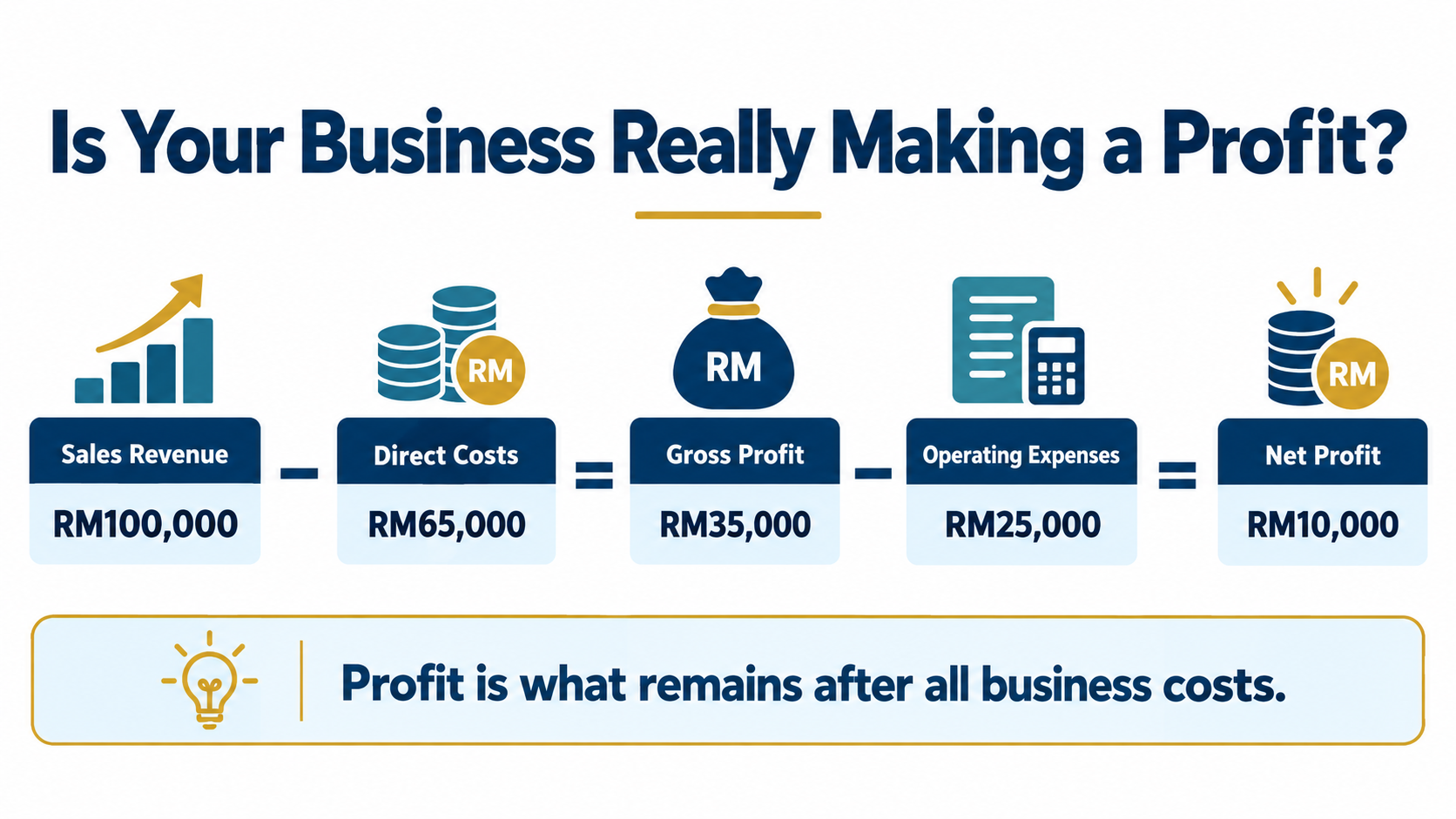
Strong sales, money in the bank and a busy operation can all look encouraging. But none of them, by itself, proves that the business is profitable. Profit is what remains after the income earned during a period is matched with every cost incurred to earn it.
Practical Guide by Thiagan ManikamPlain explanation · Example · Action to take
The Short Answer
Profit is what remains after all costs belonging to the period are deducted from sales. Check the result after direct costs, overheads and necessary accounting adjustments—not the bank balance alone.
At A Glance
CheckWhat it tells you
SalesIncome earned from customers
Direct costsCost of products, services or jobs sold
OverheadsSalaries, rent and other operating costs
AdjustmentsAccruals, inventory and depreciation
A Simple Example
Sales RM100,000 − direct costs RM65,000 − operating expenses RM25,000 = RM10,000 net profit.
What To Do
Step 1. Review the monthly Profit and Loss Account.
Step 2. Compare profit with budget and earlier periods.
Step 3. Check whether all income and costs were recorded.
Step 4. Investigate the largest changes.
Avoid These Mistakes
Using sales as proof of profit
Treating cash in the bank as profit
Ignoring owner time or shared costs
Reviewing only the year-end result
Key Takeaway
Measure profit after all relevant costs, then compare and investigate the result.
Read More Detail
What profit really means
A business makes a profit when its revenue is greater than all the related costs for the same period. The words same period are important. If you measure September sales, you should also include the costs connected with those September sales—even if some customer invoices have not been collected or some supplier bills have not yet been paid.
The basic calculation has two stages:
Sales revenue − direct costs = gross profitGross profit − operating expenses = net profit
Direct costs are costs closely connected with producing a product or delivering a service. Examples include goods purchased for resale, raw materials, subcontractors, delivery costs for a particular job and direct labour. Operating expenses keep the wider business running: office salaries, rent, utilities, software, professional fees, marketing, insurance and depreciation.
Net profit is the amount left after both groups of costs. It is more meaningful than sales alone because a business can have high sales but still earn little—or even make a loss—when its costs are too high.
A practical Malaysian SME example
Imagine a small Selangor trading company that records RM100,000 of sales in one month. The stock sold cost RM65,000. Its gross profit is therefore RM35,000, giving a gross profit margin of 35%.
Sales revenueRM100,000
Less: cost of goods sold(RM65,000)
Gross profitRM35,000
Less: operating expenses(RM25,000)
Net profitRM10,000
The company earned RM10,000, or 10% of sales, before considering any applicable tax. That sounds clear—but only if the figures are complete. Suppose the owner has not recorded RM4,000 of unpaid staff incentives, RM2,000 of stock damage and RM1,500 of monthly equipment depreciation. Once those costs are included, the more realistic profit is only RM2,500.
This is why a cash balance or an incomplete bookkeeping report can be misleading. The bank balance may include money collected from earlier sales, a bank loan or deposits received for work not yet completed. It may also exclude bills that have not yet been paid. Cash and profit are connected, but they are not the same.
How to check your true monthly profit
Confirm all revenue earned. Include completed sales or services for the month, not merely the cash received. Check invoices, delivery orders, job sheets and credit notes.
Match the direct costs. Record the stock, materials, subcontracting, labour and delivery costs related to those sales. Adjust for closing inventory so unsold stock is not treated as a cost of sales too early.
Include every operating expense. Record paid and unpaid expenses. Accrue items such as salaries, utilities, professional fees or bonuses when they relate to the month.
Allow for non-cash costs. Depreciation represents the use of vehicles, machinery, computers and other assets. Ignoring it can overstate profit.
Separate business and personal transactions. Owner drawings are generally not a business expense, while genuine business costs paid personally may still need to be recorded correctly.
Compare the result. Review gross and net profit against the previous month, the same month last year, budget and year-to-date figures. Investigate significant changes rather than looking at one number in isolation.
Common mistakes that make profit unreliable
Treating money received as sales even when the work has not been completed.
Recording purchases as costs without adjusting for stock still on hand.
Leaving unpaid supplier invoices and accrued expenses out of the month.
Forgetting discounts, sales returns, damaged stock, wastage or bad debts.
Mixing loan proceeds, owner capital or asset-sale receipts with normal revenue.
Reviewing total profit without checking profit by product, service, job or customer.
Waiting for annual accounts, when the information is too late for monthly decisions.
Concise monthly profit checklist
All sales invoices, credit notes and completed work recorded
Direct costs matched to the sales earned
Closing stock counted or reasonably verified
Unpaid expenses and commitments included
Depreciation and other month-end adjustments posted
Personal and business transactions separated
Gross profit margin compared with earlier periods
Unusual movements explained before decisions are made
What should you do with the result?
If profit is lower than expected, do not immediately cut every expense. First locate the cause. Sales volume may have fallen, selling prices may be too low, discounts may have increased, material costs may have risen, or the business may be taking on work that uses time but produces little margin. The right action depends on the reason.
A reliable monthly Profit and Loss Account should help you ask better questions: Which sales create the best margin? Which costs are rising? Is a customer or product consuming more resources than expected? How much profit is needed to support future cash requirements and growth?
When professional help may be appropriate
Consider speaking with an accountant or financial management adviser when monthly figures arrive late, stock and cost records are unreliable, important expenses are missing, margins change without explanation, or the accounts show a profit that does not fit what is happening in the business. Professional help may also be useful when setting up product, job or customer profitability reporting.
This guide is educational and does not provide individual tax or legal advice. Tax treatment and statutory reporting can differ according to the business and transaction, so obtain advice from an appropriately qualified professional where necessary.