A discount can help win an order, move stock or encourage faster payment. But it comes directly out of the amount available to cover overhead and profit. Before saying yes, calculate the ringgit effect and decide what the business will receive in return.
Practical Guide by Thiagan ManikamPlain explanation · Example · Action to take
The Short Answer
A discount is affordable only if the remaining contribution, extra volume, cash timing and customer value still support the business.
At A Glance
Before approvingCheck
ContributionProfit remaining after variable costs
Extra volumeAdditional sales needed to recover the discount
CapacityWhether extra work can be handled efficiently
Cash timingWhen the customer will actually pay
A Simple Example
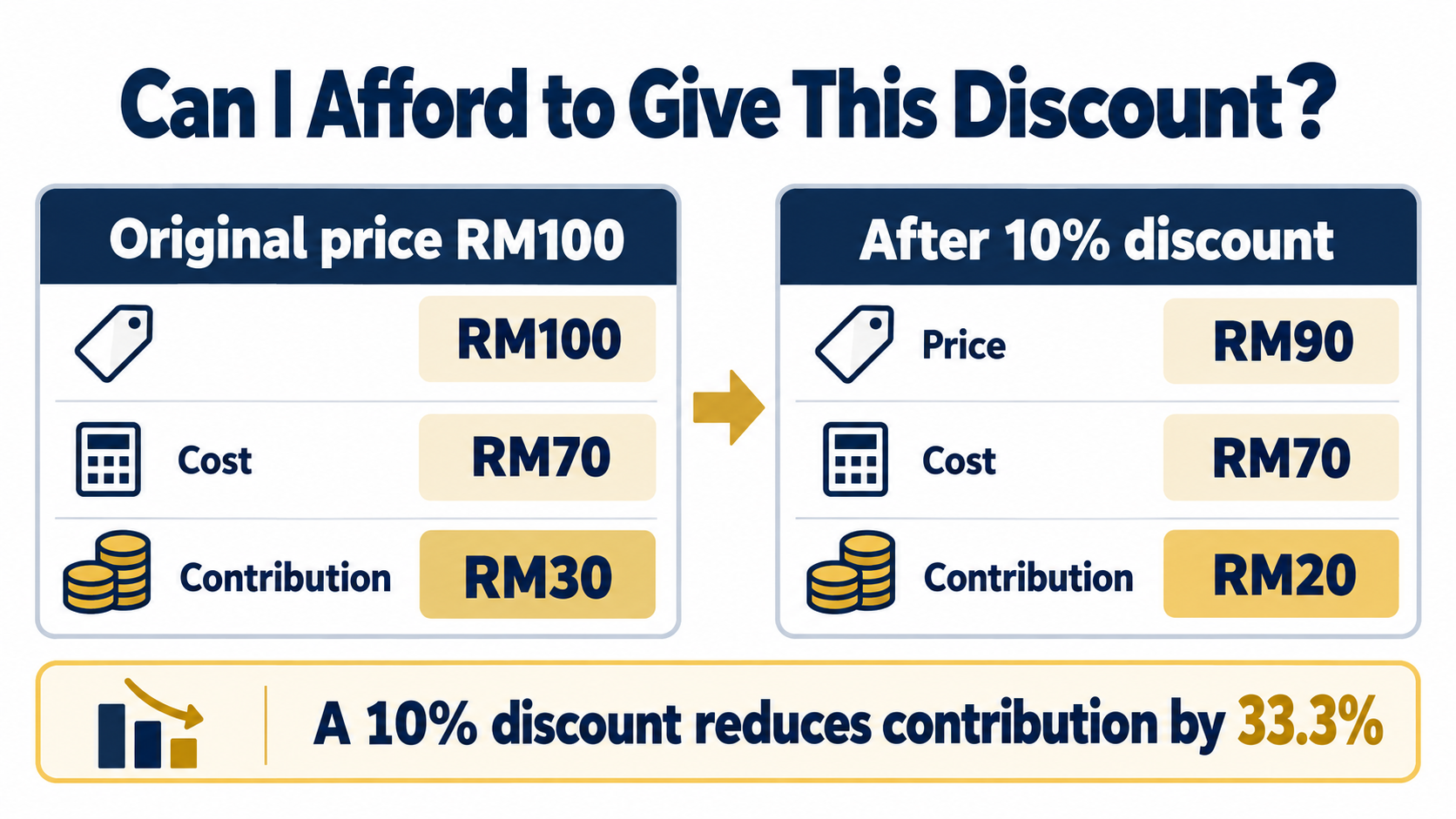
Reducing a RM100 price to RM90 while variable cost remains RM70 cuts contribution from RM30 to RM20—a one-third reduction.
What To Do
Step 1. Calculate contribution before and after.
Step 2. Find the extra volume required.
Step 3. Consider payment terms and service costs.
Step 4. Set approval limits and an end date.
Avoid These Mistakes
Looking only at discount percentage
Assuming volume will increase
Ignoring existing capacity limits
Making temporary discounts permanent
Key Takeaway
Test the effect on contribution and cash before reducing the price.
Read More Detail
A 10% discount can cost much more than 10% of profit
Owners sometimes treat a discount as a small reduction in sales. The cost of supplying the product or service, however, may stay almost unchanged. The discount therefore reduces contribution: the amount left after the costs attributable to the sale. That contribution is needed to pay rent, administrative salaries, software, insurance, financing costs and, finally, provide a profit.
Selling price − costs attributable to the sale = contributionDiscounted price − the same costs = lower contribution
Suppose an item normally sells for RM100 and its attributable cost is RM70. The contribution is RM30. A 10% discount lowers the price to RM90, but if the cost remains RM70, contribution falls to RM20. Sales value has fallen by 10%, while contribution has fallen by 33.3%. This does not mean the discount is automatically wrong. It means management should see its full effect before approving it.
A realistic Malaysian SME example
Consider a Selangor trading company preparing a quotation for 1,000 units. Its normal selling price is RM50 per unit, and the product, packing, commission and delivery attributable to the order cost RM35 per unit. The customer requests an 8% discount because the order is large.
Quotation comparisonNormal / discounted
Selling price per unitRM50 / RM46
Cost per unitRM35 / RM35
Contribution per unitRM15 / RM11
Contribution on 1,000 unitsRM15,000 / RM11,000
Contribution given upRM4,000
The 8% discount reduces revenue by RM4,000 and contribution by the same RM4,000—a 26.7% reduction in contribution. To earn the original RM15,000 at RM11 per unit, the company would need to sell about 1,364 units. That is roughly 36.4% more units, assuming costs, capacity and delivery arrangements do not change.
The larger order might still be worthwhile if it reduces packing or transport cost per unit, secures prompt payment, uses genuinely spare capacity or supports a valuable relationship. Those benefits should be estimated and documented rather than assumed.
Ask what the business receives in return
A discount should normally be exchanged for something measurable. Examples include a larger confirmed quantity, payment before delivery, a shorter credit period, a longer contract, standard packaging, fewer delivery points or a firm order schedule that improves purchasing. A vague promise of “more business later” is difficult to value.
Check whether the promised benefit actually reduces cost or risk. A bigger order is not automatically better if it requires overtime, extra storage, urgent purchasing or extended credit. Faster payment can improve cash flow, but compare the value of receiving cash earlier with the contribution surrendered. If a customer receives both a discount and long payment terms, the business may be giving away margin while also financing the customer.
Calculate the volume needed to recover the discount
One useful test is to calculate how many additional units must be sold to replace the contribution lost. In the RM100 example, contribution falls from RM30 to RM20. To earn RM3,000, the business previously needed 100 units. After discounting, it needs 150 units. That is 50 additional units—not merely 10 more.
Required volume = target total contribution ÷ contribution per discounted unitThen check whether demand, stock, staff and delivery capacity can support that volume.
This calculation assumes the cost per unit remains unchanged. If a larger quantity earns a genuine supplier rebate or spreads one delivery cost over more units, recalculate using the revised cost. If overtime, wastage or special handling increases, include those costs too. Use realistic evidence rather than the most optimistic outcome.
Practical steps before approving a discount
Start with the normal price. Confirm the current approved price and any existing rebates, credit notes or free services.
Calculate attributable cost. Include product or materials, productive labour, commission, packaging, delivery, payment charges, rework and other costs caused by the sale.
Calculate contribution before and after. Show both the ringgit amount and percentage change; do not look only at the discount rate.
Test the recovery volume. Work out the additional units or jobs required to recover the contribution given up.
Value what is received. Record the confirmed volume, earlier payment, cost saving or other measurable benefit linked to the discount.
Check capacity and cash. Make sure stock, staff, equipment and working capital can support the order without creating a new problem.
Set limits and an end date. State who may approve the discount, for which customer and order, and when the arrangement will be reviewed.
Compare forecast with actual results. Confirm that the customer purchased the promised quantity and that actual costs and payment timing matched expectations.
Common mistakes
Comparing the discount percentage with sales instead of its percentage effect on contribution.
Assuming that selling more units automatically restores profit.
Ignoring delivery, commission, overtime, rework or financing costs.
Giving a discount for volume that the customer has not firmly committed to buy.
Allowing sales staff to discount without a clear contribution floor or approval limit.
Making a temporary discount permanent by failing to state an end date.
Giving both a lower price and longer credit without assessing the combined effect.
Using an old product cost after supplier prices, exchange rates or wages have changed.
Quick discount checklist
Normal price and attributable cost are current
Contribution before and after discount is calculated
Additional volume needed is realistic
Customer commitment is written and measurable
Payment terms and collection risk are considered
Stock, capacity and working-capital needs are checked
Approval responsibility and minimum contribution are clear
Discount has an end date and review date
When professional help may be useful
Consider help from an accountant or financial management adviser when costs are incomplete, salespeople use many different discounts, contribution varies widely by customer, or the business cannot tell whether higher volume improves profit. They can help establish reliable product or job costs, approval limits and a simple discount report.
Seek appropriately qualified tax or legal advice when a proposed arrangement involves SST treatment, competition requirements, contractual obligations, rebates or other issues specific to the transaction. This article is general educational guidance and does not determine the correct commercial, tax or legal decision for an individual business.