What does “cover all my costs” mean?
At the break-even point, sales pay for the costs of making or delivering what you sell and the regular costs of keeping the business open. Profit is zero. Selling less usually produces a loss; selling more can produce a profit, provided the price and cost pattern stay broadly the same.
First separate costs into two useful groups. Variable costs generally rise with each sale: merchandise purchased for resale, materials, per-job subcontractors, packaging, or commissions. Fixed costs generally remain over the relevant range of monthly activity: rent, permanent staff salaries, software subscriptions and other overheads. “Fixed” does not mean permanent forever; a second shift or larger premises may make these costs jump.
The amount left from sales after variable costs is called contribution. It first pays fixed costs. Once those are covered, the remainder contributes to profit. The contribution margin is contribution divided by sales. It is different from net profit margin because fixed costs have not yet been deducted.
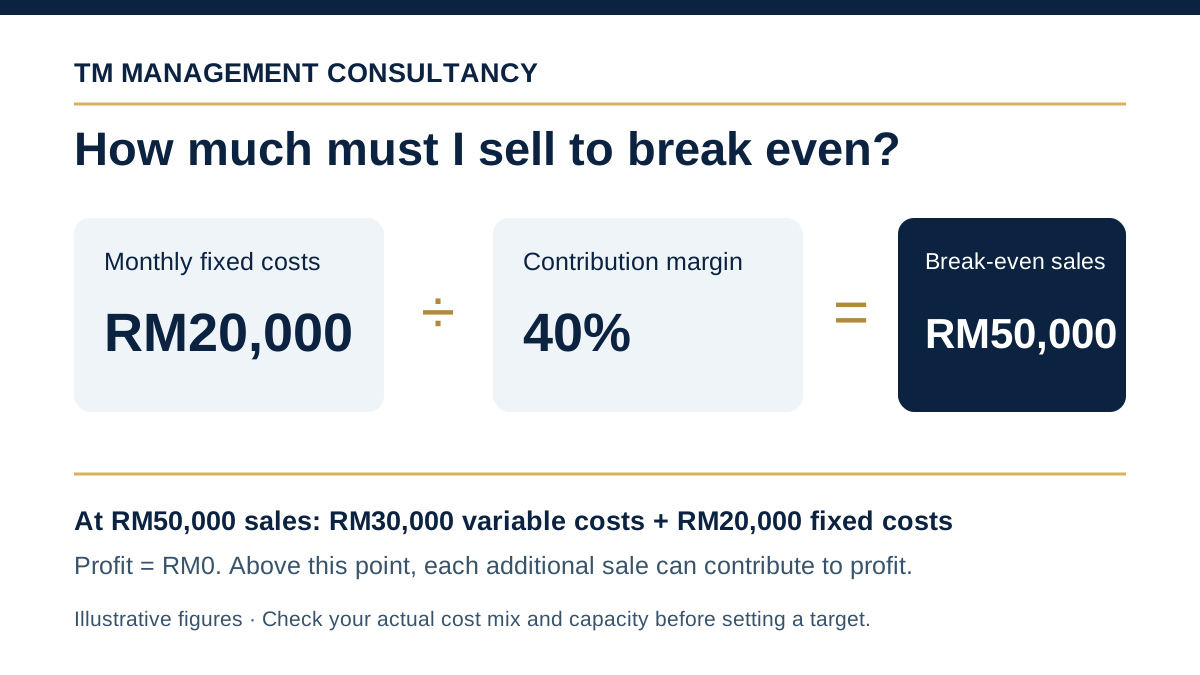
Sales − variable costs = contributionFixed costs ÷ contribution margin = break-even sales
A Malaysian SME example
Imagine a Puchong trading business selling packaging supplies. Start by listing the costs it must meet each month even if sales are low. Check rent agreements, payroll, utility bills, insurance, software subscriptions and the accounts for recurring overhead. The amounts below are illustrative monthly figures. For annual costs, divide the yearly amount by 12; for a mixed cost such as utilities, estimate its regular portion and put the sales-related portion with variable costs.
1Identify the monthly fixed costs
Fixed cost to identifyMonthly amount
Premises rentRM5,000
Regular salaries and employer costsRM10,000
Regular portion of utilitiesRM1,500
Insurance (annual premium ÷ 12)RM1,000
Software subscriptionsRM500
Other recurring overheadRM2,000
Total monthly fixed costsRM20,000
Include a reasonable salary for the owner’s work if it is not already in regular salaries and the calculation is meant to cover that work. Avoid counting the same item twice. The exact mix of fixed costs will differ by business.
2Work out the sales needed to break even
Use a recent, representative period to estimate the share of each sales ringgit left after costs that vary with sales. Suppose RM50,000 in net sales produces RM30,000 in stock costs, delivery and sales commission. These variable costs use 60 sen of each RM1 sold, leaving 40 sen to cover fixed costs.
Step and workingResult
Net sales in sample monthRM50,000
Less: costs that vary with sales(RM30,000)
Contribution: RM50,000 − RM30,000RM20,000
Contribution margin: RM20,000 ÷ RM50,00040%
Monthly fixed costs (from table above)RM20,000
Break-even sales: RM20,000 ÷ 40%RM50,000
Check the answer: RM50,000 sales − RM30,000 variable costs − RM20,000 fixed costs = RM0 operating profit. This is an illustrative profit calculation, not a forecast of cash receipts. It assumes the prices, cost mix and capacity stay broadly the same; do not use a margin based on incomplete accounts.
If sales reach RM60,000 at the same prices and cost mix, contribution is RM24,000 and profit is approximately RM4,000. If sales fall to RM40,000, contribution is RM16,000 and the business loses approximately RM4,000. Every additional RM10,000 of sales changes profit by RM4,000 in this simplified example—not by RM10,000.
Turn the calculation into a sensible target
Break-even is the minimum operating target, not a comfortable business goal. An owner may also need a return for their work, funds to replace equipment, and room for unexpected repairs or weaker months. If the business wants RM8,000 monthly operating profit with the same 40% contribution margin, it needs (RM20,000 fixed costs + RM8,000 target profit) ÷ 40% = RM70,000 sales.
Then check whether that sales level is achievable with current stock, staff and capacity. A target based on last year’s margin can mislead when purchase prices, discounts or product mix have changed. Also remember that accounting profit is not cash in the bank: customers may pay later while suppliers, salaries and loan instalments are due now. Read the related Protect Cash questions alongside this calculation.
Practical steps for your business
- Choose a clear period. Start with one normal month. Use the same period for sales and costs, excluding one-off transactions you have identified and explained.
- List variable costs. For each sale or job, include direct materials or stock, delivery, commissions and other costs that change with volume. Some costs contain both fixed and variable parts; estimate and document the split.
- List fixed costs. Include rent, regular salaries, utilities, insurance and other recurring overheads. Account for a reasonable owner salary if the owner’s work would otherwise have to be paid for.
- Calculate contribution margin. Divide contribution by sales, using recent, reliable figures. Review separately if product or customer margins differ greatly.
- Calculate break-even and desired-profit sales. Divide fixed costs by the margin percentage, then add a realistic profit objective to fixed costs for a fuller target.
- Test the result. Ask what happens if prices fall, materials rise, demand weakens or another employee becomes necessary. Review the calculation monthly and after major cost or price changes.
Common mistakes to avoid
- Dividing fixed costs by gross margin without checking whether all relevant variable costs have been included.
- Treating every cost as perfectly fixed or variable when mixed costs need an estimate.
- Using average margin across very different products and assuming every new sale has that same margin.
- Leaving the owner’s labour or regular overhead out, making the target look too low.
- Assuming additional sales can be handled without extra staff, space or equipment.
- Confusing break-even profit with the cash needed for stock purchases, tax, debt repayments or late-paying customers.
- Relying on incomplete sales, stock or expense records. Correct the underlying numbers before making a large decision.
Quick break-even checklist
- Sales and costs relate to the same month
- Variable costs include all relevant per-sale or per-job costs
- Fixed costs include recurring overhead and owner labour where appropriate
- Contribution margin is based on current prices and costs
- Break-even sales are compared with realistic capacity and demand
- Desired profit and cash needs are considered separately
- The target is reviewed when prices, costs or sales mix change
When to get professional help
An accountant or financial management adviser can help when costs are hard to classify, stock records are unreliable, jobs have very different margins, or the business is considering expansion based on a narrow break-even calculation. They can help build a practical product or job costing method and test several scenarios rather than supplying one misleading number.
This guide is educational. It is not individual tax or legal advice; obtain appropriately qualified advice for tax treatment, statutory obligations or contract questions.