The Short Answer
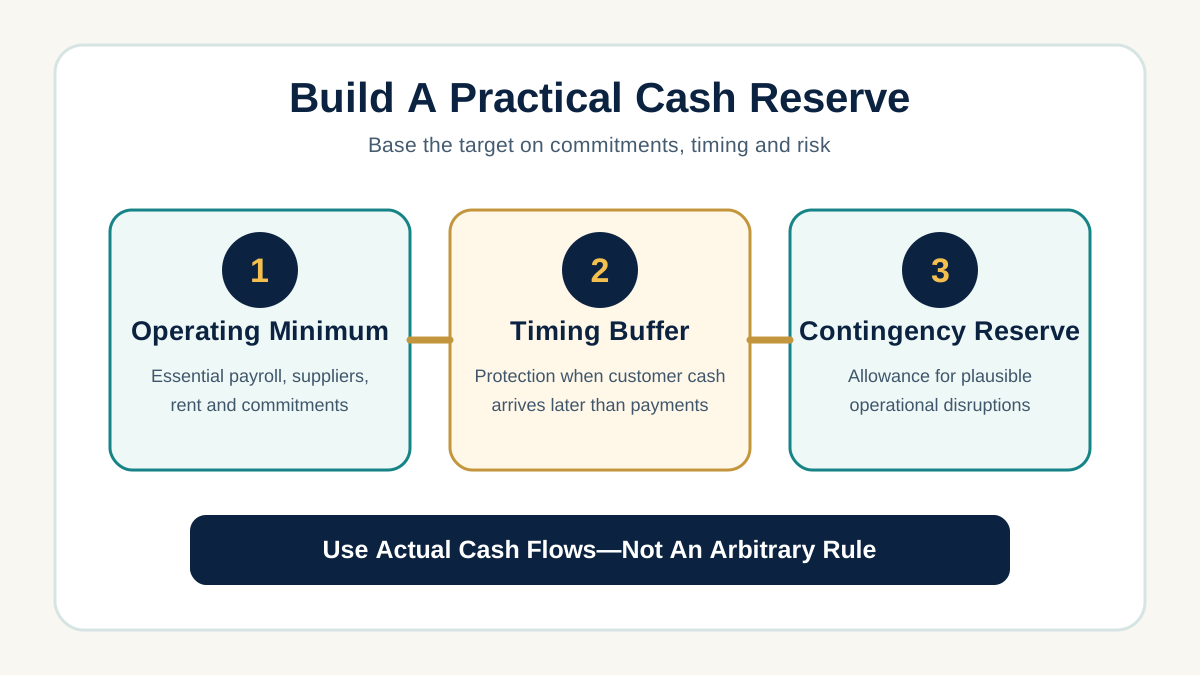
Step 1: List Essential Monthly Payments
Start with payments the business must make even during a difficult month.
Step 2: Allow For Late Customer Payments
Use a weekly cash-flow forecast to see what happens if a major customer pays later than expected.
Step 3: Add A Realistic Emergency Allowance
Consider an event that could interrupt normal operations and require immediate cash.
Use plausible risks. Do not provide for every imaginable problem.
A Simple Example
The business needs RM65,000 for essential monthly payments. It may need another RM30,000 if a major customer pays late and RM15,000 for an unexpected repair.
This is only an example. Every business should use its own expenses, customer payment patterns and operating risks.
How To Build And Use The Reserve
Read The More Detailed Answer
Start With The Purpose Of The Reserve
A cash reserve is money kept available to protect normal operations when receipts are delayed or an unexpected payment arises. It is not the same as surplus cash available for expansion, dividends or non-essential purchases.
The reserve should give management enough time to respond calmly. Without it, a short delay in customer collections can quickly lead to late salaries, missed supplier payments or costly emergency borrowing.
Choose A Practical Reserve Period
Some businesses use a number of months as a starting point, but the correct period depends on how predictable the business is. A stable business with regular monthly receipts may need a smaller buffer than a seasonal business or one that depends heavily on a few customers.
Count Only Cash That Is Truly Available
Do not assume the full bank balance is the reserve. Part of that balance may already be needed for tax, payroll, loan instalments, supplier payments or customer deposits. Restricted funds and amounts committed to near-term payments should be excluded.
Use The Cash-Flow Forecast To Test The Target
A reserve target should be tested against a rolling weekly cash-flow forecast. Change one assumption at a time and observe the lowest projected cash balance.
If a realistic test causes cash to fall below zero, the reserve may be too low or management may need a confirmed backup facility.
Keep The Reserve Separate And Controlled
The reserve may be held in a separate bank account or clearly identified in the cash records. The important point is that everyone understands it is not part of the normal spending balance.
Set simple rules covering when the reserve may be used, who approves the withdrawal and how it will be rebuilt. Use it for temporary timing gaps and genuine emergencies—not to hide continuing operating losses.
Do Not Rely Entirely On Borrowing
An overdraft or credit facility can support the cash plan, but it should not automatically replace the reserve. A facility may be reduced, withdrawn or unavailable when the business needs it most. Count it as backup only when it is approved, available and its conditions are understood.
Review The Target Regularly
Review the reserve at least whenever the business changes materially. The target should move with the business rather than remain fixed for years.
Avoid These Mistakes
- Choosing a figure without checking actual payments.
- Treating the full bank balance as available cash.
- Assuming every customer will pay on time.
- Counting unapproved financing as available money.
- Using the reserve repeatedly to cover business losses.
Quick Review
- How much must the business pay each month?
- What happens if the largest customer pays late?
- Which emergency could require immediate cash?
- Who may approve use of the reserve?
- How will the reserve be rebuilt?
Key Takeaway
Keep enough cash for essential payments, likely collection delays and realistic emergencies. Review the target whenever sales, costs, payment terms or business risks change.
This guide provides general educational information. Significant funding, tax or solvency decisions should be assessed using the business’s actual position and appropriate professional advice.