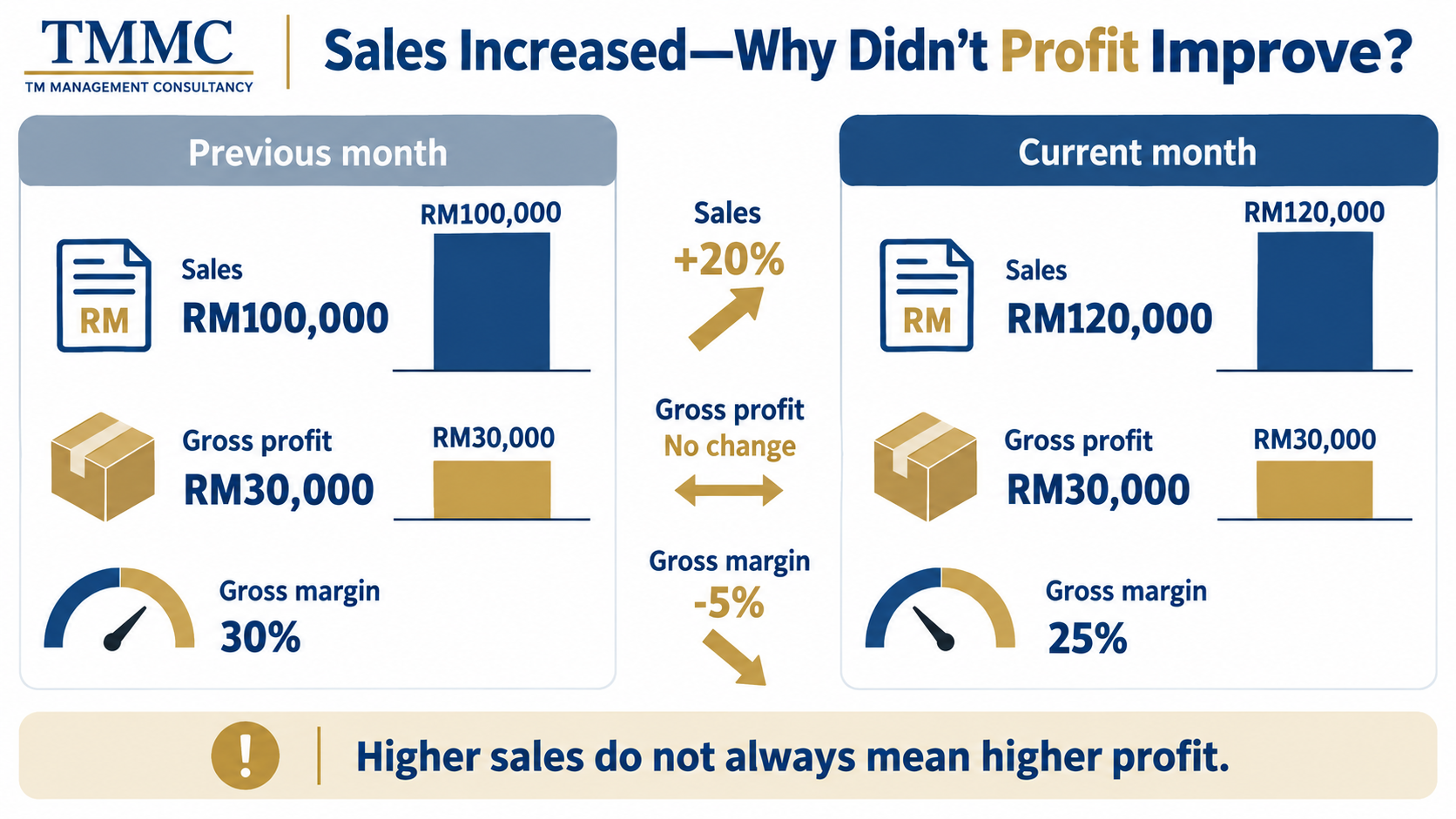
Why Are Sales Increasing but Profit Is Not Improving?
Higher sales usually feel like good news. More orders are being processed, staff are busier and more invoices are going out. Yet the month-end accounts may show that profit has hardly moved—or has fallen. The answer is often hidden in the margin earned from each sale and the extra costs required to support the growth.
Practical Guide by Thiagan ManikamPlain explanation · Example · Action to take
The Short Answer
Higher sales do not guarantee higher profit. Discounts, lower-margin sales, rising costs, overtime, rework or added overheads may absorb the additional revenue.
At A Glance
Possible causeWhat to examine
Lower selling pricesDiscounts and price changes
Higher direct costsMaterials, labour and delivery
Sales mix changedMore low-margin products or customers
Overheads increasedNew payroll, rent or operating costs
A Simple Example
Sales rise from RM100,000 to RM120,000, but gross profit stays at RM30,000. The additional RM20,000 of sales added no gross profit.
What To Do
Step 1. Compare gross margin percentages.
Step 2. Analyse products, customers or jobs separately.
Step 3. Check discounts and cost increases.
Step 4. Review whether added overheads are productive.
Avoid These Mistakes
Focusing only on revenue
Using average margins for every sale
Ignoring rework and special service costs
Assuming growth will automatically improve cash
Key Takeaway
Track the profit produced by additional sales—not sales growth alone.
Read More Detail
Sales and profit measure different things
Sales revenue is the value invoiced for goods or services. Profit is what remains after the related costs are deducted. A business can therefore increase sales without improving profit if the additional sales carry a lower margin, require more resources or create new operating expenses.
Sales − direct costs = gross profitGross profit − operating expenses = net profit
The gross profit margin is especially useful because it shows how much gross profit is retained from every RM100 of sales. A 30% margin means RM30 remains after direct costs. If the margin falls to 25%, only RM25 remains. The business then has less available to pay salaries, rent, financing costs and other overheads—even though revenue is higher.
A practical Malaysian SME example
Consider a Selangor distributor. Last month it made RM100,000 in sales and the products sold cost RM70,000. Gross profit was RM30,000, or 30% of sales. This month sales rise by 20% to RM120,000. However, the company gives larger discounts to win the extra orders, purchases some items at higher prices and pays additional delivery charges. Direct costs rise to RM90,000.
Previous month salesRM100,000
Previous month direct costs(RM70,000)
Previous gross profit (30%)RM30,000
Current month salesRM120,000
Current month direct costs(RM90,000)
Current gross profit (25%)RM30,000
Sales increased by RM20,000, but gross profit did not increase at all. If the busier month also required RM3,000 of overtime and temporary administrative help, net profit would actually be lower. The problem is not necessarily the sales increase itself. The problem is that management cannot see which price, cost, customer or product changes consumed the benefit.
Why this happens
Discounts grow faster than volume. A discount reduces profit on every affected sale. The extra quantity must be large enough to recover the profit given away.
The sales mix changes. Total revenue may rise because lower-margin products, services or customers make up a bigger share of sales.
Supplier and delivery costs increase. Purchase prices, freight, fuel, subcontracting and packaging may rise without an equivalent selling-price adjustment.
Hidden service costs increase. Urgent deliveries, rework, overtime, returns, special handling and extended support can make a large order less profitable than it appears.
Capacity costs step up. Growth may require another employee, vehicle, warehouse or software plan. These costs may remain even if the extra sales later disappear.
Records are incomplete. Missing stock adjustments, supplier invoices or accruals can make comparisons unreliable and hide the true cause.
How to investigate the change
Compare like with like. Put the current month beside the previous month, the same month last year, budget and year-to-date results. Compare sales, gross profit in RM and gross margin percentage.
Break sales into useful groups. Review revenue and margin by product, service, job, branch or customer. Total sales can conceal strong and weak areas.
Separate price, volume and mix. Ask whether growth came from selling more units, charging a higher price or selling a different combination. These changes have different effects on profit.
Trace direct-cost movements. Check recent supplier prices, wastage, freight, commissions, overtime and subcontracting. Confirm that inventory is measured consistently.
Review discounts and exceptions. List special prices, free delivery, credit notes, returns and non-standard customer requests. Make the full cost visible before approving similar deals.
Agree on a specific action. The answer may be to revise selected prices, negotiate a supplier rate, set discount limits, charge for special services or stop pursuing work that cannot meet the required margin.
Common mistakes
Celebrating revenue growth without checking gross profit and margin.
Assuming the largest customer or product is automatically the most profitable.
Cutting general expenses before identifying where the margin was lost.
Using one standard cost even after materials, labour or delivery prices have changed.
Giving discounts without calculating the additional sales needed to replace lost profit.
Ignoring the owner’s or employees’ extra time spent servicing complex orders.
Comparing incomplete monthly accounts and treating the result as final.
Concise monthly sales-and-margin checklist
Sales, gross profit and gross margin reviewed together
Current results compared with prior periods and budget
Margin reviewed by product, service, job or customer
Discounts, returns and credit notes checked
Supplier, freight and labour cost changes updated
Overtime, rework and special service costs identified
Unusual margin movements explained
Actions assigned to a person with a deadline
What should management do next?
Do not respond by increasing sales targets blindly or cutting every expense. First identify where the margin changed and whether the lower margin was deliberate. A temporary lower margin may be reasonable for clearing old stock or entering a carefully chosen market, but management should know the expected benefit, duration and minimum acceptable return.
Set a small number of measures for the next monthly review: sales, gross profit in RM, gross margin percentage, average discount and margin for the products, services or customers that matter most. Assign each corrective action to a person and check whether it restored profit. This turns the accounts into a management tool rather than a historical record.
When professional help may be appropriate
Consider getting help from an accountant, costing specialist or financial management adviser when the accounting system cannot show margins by product, job or customer; stock and direct costs are unreliable; margins keep falling without a clear explanation; or pricing decisions are being made without current cost information. A professional can help design a practical costing method and a short monthly report that management can use.
This article is educational and does not provide individual tax or legal advice. Obtain advice from an appropriately qualified professional when a decision involves tax treatment, contracts or statutory requirements.